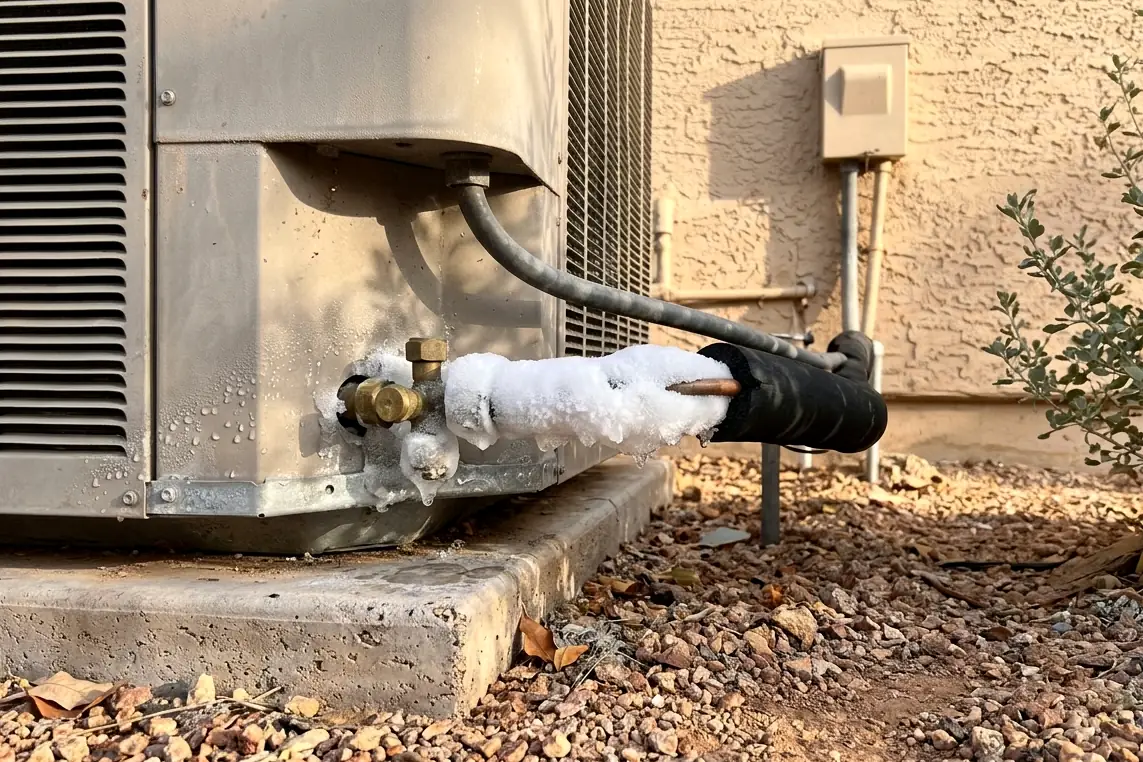
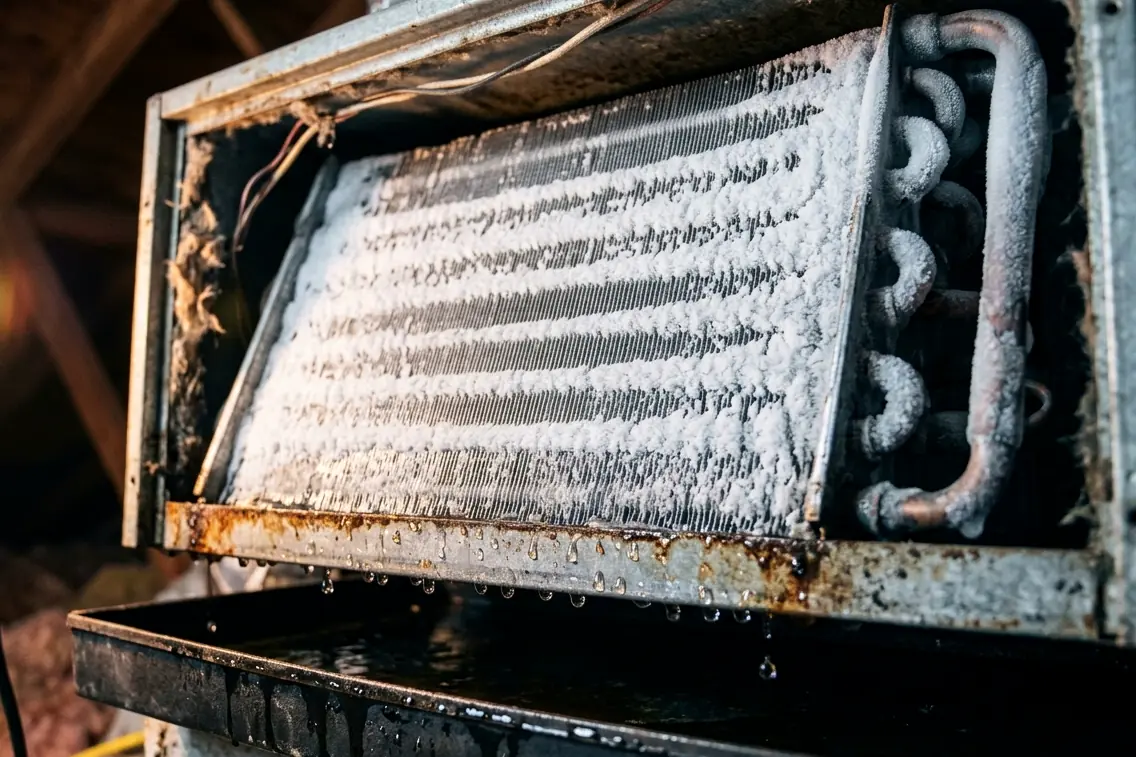
Ice on the copper line or indoor coil means the coil is running colder than 32°F. The usual causes are low airflow from a clogged filter, dirty coil or weak blower, or low refrigerant from a leak. Turn cooling off, run the fan only to melt the ice, replace the filter and check the drain. If ice returns after a full thaw, call a technician to test airflow and refrigerant charge.
Why does ice form on an AC in the desert?
Your evaporator coil is designed to run cold, typically somewhere around the upper 30s to low 40s °F, which is cold enough to cool and dry the air but just above the point where moisture turns to ice. When something pushes the coil below 32°F, the moisture it pulls from the air ices over on the coil fins instead of dripping into the drain pan. Once ice starts forming, it blocks airflow, which makes the coil even colder, and the ice spreads.
Outdoor heat does not prevent this, because the problem is happening inside the system, not outside it. In Phoenix the ice often first shows up on the larger insulated copper line at the outdoor unit, called the suction line, and on the air handler cabinet in a closet or attic. By the time you see it outside, the indoor coil is often a solid block.
What should you do in the first hour?
Acting quickly limits the damage. Running the compressor with an iced coil can send liquid refrigerant back to the compressor, which is hard on it and can shorten its life. Melting the ice the right way also protects your ceilings and floors from a sudden flood of water, which matters most in homes where the air handler sits in the attic above finished rooms.
- Switch the thermostat from cool to off
- Set the fan to on so warm room air melts the ice
- Pull the filter and replace it if it is dirty
- Check that the drain pan and drain line are flowing
- Leave cooling off until all ice is completely gone
- Never chip or scrape ice off the coil or lines
How long does a full thaw take?
With the fan running, light frost may clear in an hour, while a heavily iced coil can take several hours or more. Do not rush it with a hair dryer or heat gun, and never chip at the ice, since a single slip can puncture a coil or line and turn an airflow problem into a refrigerant leak repair. Patience is the cheapest part of this process.
Watch the drain while it thaws. A coil that iced over can release a lot of water in a short time, and Phoenix drain lines are often partly clogged with algae and hard-water sludge. If the pan under an attic air handler fills up, water can spill into the ceiling. A wet-dry vacuum at the drain line opening outside can help clear a slow line. If you see water spotting on a ceiling, call right away.
Which airflow problems cause icing?
Low airflow is the most common cause we find, and it is often something simple. Anything that reduces the air moving across the coil lets it run too cold, and the problem often builds slowly over a few weeks before ice finally appears. Some of these causes are easy for a homeowner to fix in a few minutes, while others need a technician with the right meters.
- Clogged or overly dense air filter
- Closed supply registers or blocked return grilles
- Dirty evaporator coil coated with dust
- Weak or failing blower motor or capacitor
- Dirty blower wheel that moves less air
- Collapsed or disconnected flex duct in the attic
When is low refrigerant the real cause?
If airflow checks out and the coil ices again after a full thaw, low refrigerant charge is the next suspect. Refrigerant does not get used up. If the charge is low, there is a leak somewhere, often at a coil, a joint or a service valve. Low charge drops the pressure in the evaporator coil, which drops its temperature below 32°F, and ice follows.
Simply adding refrigerant without finding the leak only delays the problem, and on an older system using R-22, each recharge is expensive because R-22 production ended in 2020. Our technicians measure pressures, superheat and subcooling to confirm low charge, then use electronic leak detection or other methods to locate the leak. From there, we explain whether a leak repair, a coil replacement or a broader system decision makes the most sense.
Can ice damage other parts of the system?
It can. The biggest risk is to the compressor, which is designed to compress vapor, not liquid. When a coil ices over, liquid refrigerant can make it back to the compressor and wear it down quickly. Overflowing condensate from melting ice can rot drywall, stain ceilings and encourage mold growth in attics and closets. Running a system repeatedly in this condition can also stress the blower motor and the indoor coil.
That is why it is worth calling sooner rather than later if ice shows up more than once. The repair that fixes the cause, whether a filter, a blower part or a leak, is almost always far less expensive than replacing a compressor that failed after weeks of running iced over. A single visit to find the root cause usually costs less than one season of repeated thaws, ceiling repairs and higher bills.
What do our technicians check when you call?
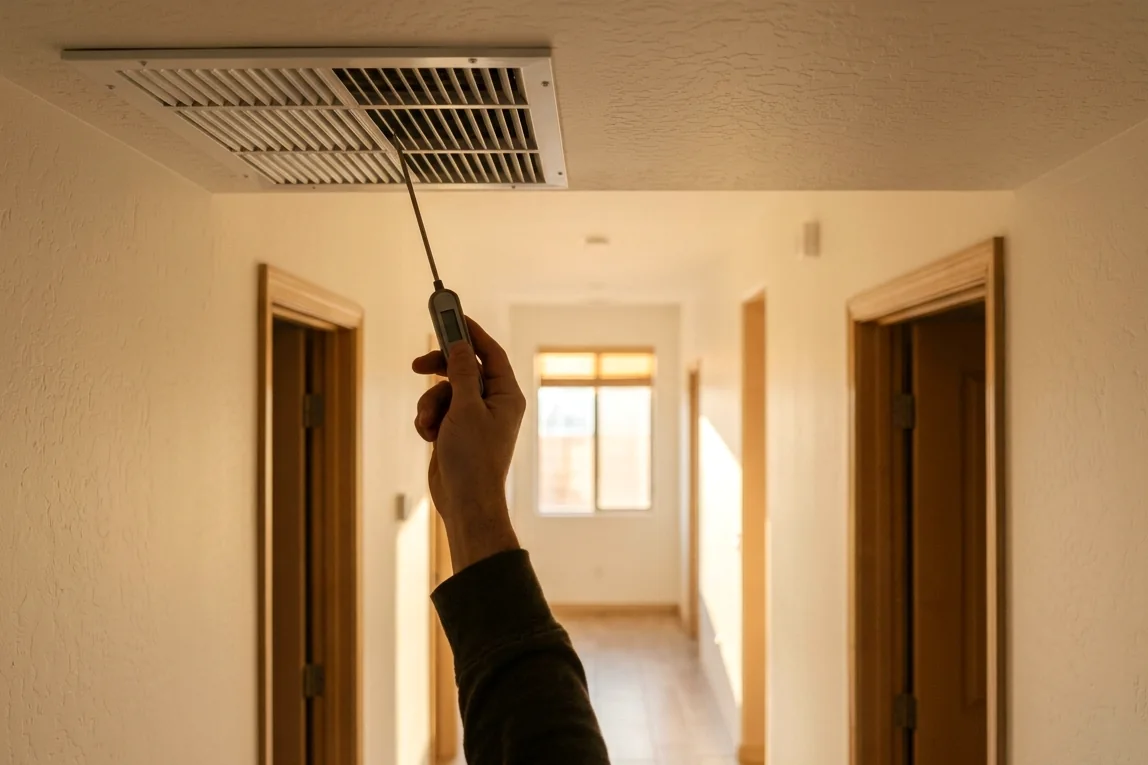
When you phone (602) 848-9399, we will ask whether the ice is still present and how long the system has been off. On site, our technician checks the filter and blower, measures temperature split, static pressure and refrigerant pressures, inspects the evaporator coil and tests the drain. You get a clear explanation of what caused the ice and the typical cost range for the fix before any work starts. We answer 24/7, so call any time, even on a holiday.