Indoor Air Quality
A measured look at dust, humidity, fresh air and odors in your home, followed by targeted fixes like better filtration, ventilation or drain repairs.
See indoor air qualityDucts, air and attic
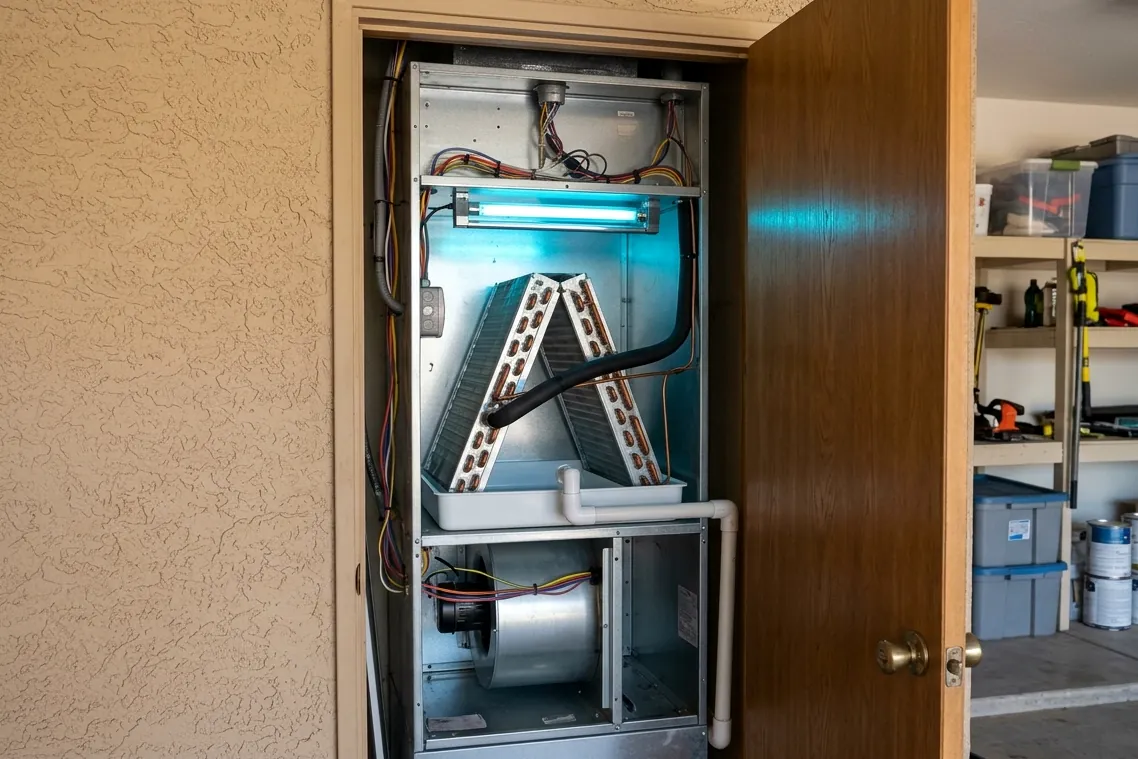
A UV lamp mounted at the indoor coil keeps the wet, dark parts of your AC from growing slime and odor. We install coil and in-duct units, choose models that don't produce ozone, and place them where they actually work.
At a glance
UV light installation adds an ultraviolet lamp inside the air handler, aimed at the indoor coil and drain pan, where moisture lets mold and bacterial film grow. Air purifier installation adds an in-duct cleaner to the airflow. In Phoenix, these make sense when the coil keeps fouling, drain lines clog with slime, vents smell musty after monsoon season, or someone at home is sensitive to odors and airborne particles.
The indoor coil on your AC is cold and wet for most of the year in Phoenix. Air passes over it, moisture condenses, and the coil sits in a dark cabinet that rarely dries out between June and September. That combination is ideal for biofilm, the slick gray-green layer that builds on fins and in drain pans. It cuts airflow, slows heat transfer and feeds the sludge that clogs condensate lines.
A UV-C lamp mounted in the air handler shines directly on the coil and pan around the clock. Its light breaks down the organic film before it can build up, so the coil stays cleaner between service visits. Unlike a filter, it doesn't add resistance to airflow. It only works on surfaces it can see, though, which is why placement matters more than the brand name on the box.
Air purifiers are a separate tool. In-duct units treat the moving air rather than a surface, and the options include UV chambers, photocatalytic cells and electronic designs. Some electronic purifiers generate ozone as a byproduct, which can irritate lungs, so our technicians steer you toward models that don't produce it. We'll explain what each type does well and where a better filter would do more for less money.
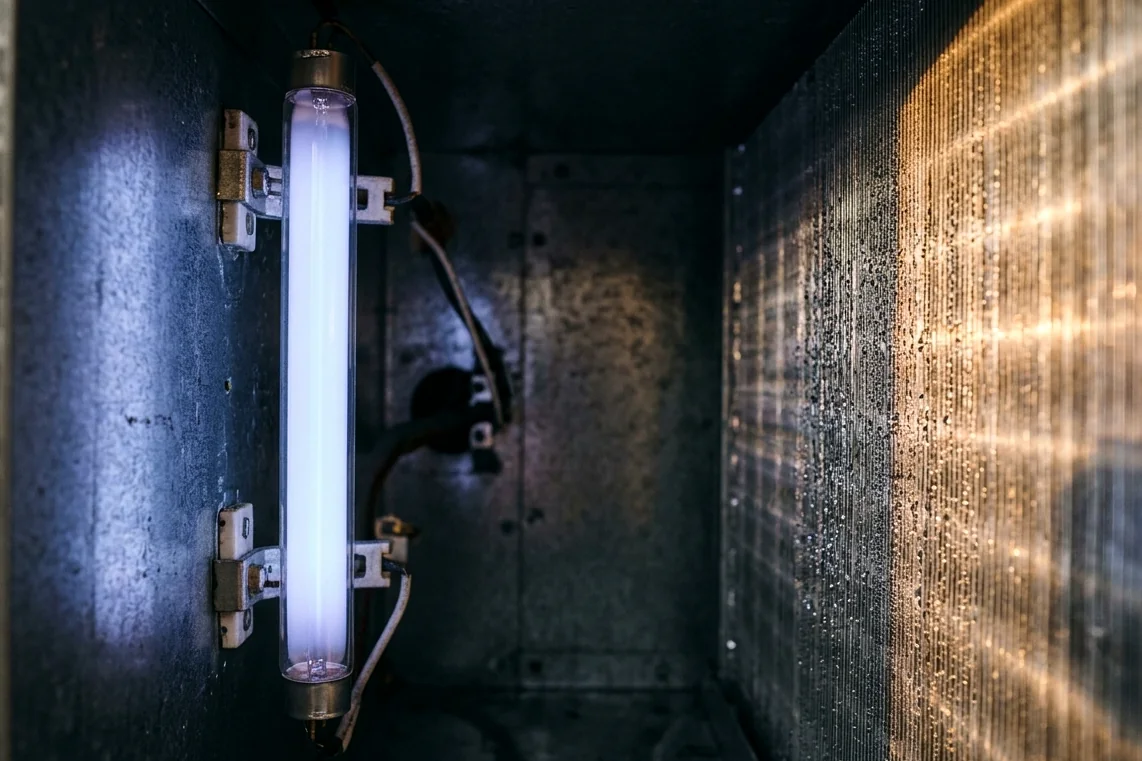
It seems odd that a desert climate would have a slime problem, but your indoor coil lives in its own humid pocket. With AC running nearly nonstop from May through October, the coil stays below the dew point of indoor air for months. Monsoon season raises outdoor humidity, more moisture gets into the house, and more water drips across the coil. Air handlers in hot attics also keep the cabinet around the coil warm, which helps growth along.
Phoenix hard water and fine dust make it worse. Dust that slips past a thin filter sticks to wet fins and gives the film something to anchor to, while mineral-heavy water helps scale build up in pans and traps. That's why many Valley drain lines clog every summer. A UV lamp aimed at the coil and pan breaks that cycle, and paired with a good filter it can cut cleaning frequency noticeably.
Typical cost
Typical installed unit. A range, not a quote: the real number depends on what the technician finds. Full price guide
A single coil-mounted UV lamp sits near the low end of this range, while in-duct purifiers and dual-lamp setups run higher. Coil cleaning, if needed, is priced separately. The real number depends on what the technician finds inside your air handler, and you hear the price before anything is mounted.
| Line item | Typical range |
|---|---|
| Coil-mounted UV light installation | $465 to $985 |
| In-duct air purifier installation | $785 to $1,645 |
| UV replacement bulb, installed | $95 to $185 |
How we handle it
The technician opens the air handler, checks the coil and drain pan condition, and measures the space available so the lamp can reach the coil face and pan without blind spots.
A UV lamp keeps a clean coil clean, but it works slowly on heavy existing buildup. If the coil is already coated, we clean it first so the system starts from a fresh surface.
Based on the inspection, we recommend a coil-mounted UV lamp, an in-duct purifier, or both. Models that produce ozone are left off the list, and you see each option with a price.
The lamp or purifier mounts through the cabinet or supply plenum and is wired to a dedicated outlet or the air handler's transformer, with the power source chosen to suit the model's design.
UV-C light can harm eyes and skin, so we install a door switch or panel interlock that shuts the lamp off whenever the cabinet is opened for service or filter changes.
You'll see the viewing port or indicator, learn the bulb replacement interval and get the part number so a later replacement is quick. Most UV bulbs need changing every year or two.
Signs to watch
If your condensate line has needed clearing more than once in a season, biofilm growing in the pan and on the coil is likely feeding the clog faster than drain tablets can stop it.
A damp, earthy odor that hits for the first few minutes of each cycle usually comes from growth on the coil or pan, released as air starts moving across the wet surfaces.
When a technician pulls the access panel and finds a gray or greenish coating on the indoor coil, a UV lamp can keep that layer from coming back after a cleaning.
A coil coated in biofilm transfers heat poorly. If your system's split has slid from around 20°F toward the low teens without a refrigerant problem, a fouled coil is a likely cause.
Homes with someone bothered by musty smells or airborne irritants often benefit from treating the coil and adding a purifier alongside better filtration at the air handler.
Attic air handlers in Phoenix run in extreme heat with condensation inside, and they are harder to reach for frequent cleaning. A UV lamp reduces how often that coil needs attention.
Before you call
Anything beyond these checks involves electrical parts or refrigerant, so call (602) 848-9399 and let a technician take it from there.
We repair and replace Trane, Carrier, Lennox, Goodman, Rheem, Daikin and most other makes found in Valley homes.
Related work
A measured look at dust, humidity, fresh air and odors in your home, followed by targeted fixes like better filtration, ventilation or drain repairs.
See indoor air qualityDeep 4 to 5 inch media filter cabinets installed at the air handler, sized for your airflow and sealed tight so desert dust stays out of the house.
See air filtrationClogged condensate line or a tripped float switch? We clear algae and scale, flush the drain, check pans and traps, and confirm water drains clearly again.
See ac drain line cleaningLeaking or corroded indoor coils replaced with matched units, brazed, pressure tested, evacuated and charged for reliable cooling.
See evaporator coilWhere we do this
These communities make up most of the homes we serve. Each link opens the local page with ZIP codes, typical homes and the issues we see there.
It helps a lot. Most drain clogs in the Valley start as biofilm in the pan and trap, and a lamp aimed at the pan slows that growth significantly. It won't remove mineral scale from hard water or dust that settles in the line, so a yearly drain flush is still a good idea. Many homeowners see far fewer summer clogs after installation.
Coil-mounted UV-C lamps sit inside a closed metal cabinet where the light can't reach living spaces, and a safety switch shuts them off when the panel opens. The bigger safety question is ozone. Some electronic purifiers create it as a byproduct, and it can irritate lungs. We recommend models that don't generate ozone and explain how to tell the difference.
Most HVAC UV bulbs lose strength over time even while they still glow, so replacement every twelve to twenty-four months is typical, with the exact interval set by the model. We'll note the install date on the unit and give you the part number. Many Phoenix homeowners line up the bulb change with their spring AC tune-up so it never gets forgotten.
A UV lamp can help indirectly. A coil that stays clean of film moves heat better and keeps airflow up, so the system may run a little shorter on hot afternoons. The lamp itself draws about as much power as a small light bulb. Air purifiers don't save energy on their own, but most in-duct designs add very little airflow resistance either.
They solve different problems. A UV lamp keeps the coil and drain pan clean; it doesn't catch dust. A media filter catches dust and pollen; it doesn't stop growth on a wet coil. For monsoon dust, filtration does more. For musty odors and slimy drains, UV does more. Many homes end up using both, starting with whichever addresses the main complaint.
Yes, in most cases. Package units on Phoenix roofs have the coil and pan inside the same cabinet as the condenser, and a lamp can usually mount through the evaporator section panel. Access is on the roof, and power comes from the unit's control circuit. We check the cabinet layout first, since some compact units leave very little room near the coil.
A real person answers (602) 848-9399 every hour of every day, and we will tell you plainly what the next step is.