AC Installation
New central air for additions, casitas, garages and homes without ducted cooling, sized by load calculation for Phoenix summer heat.
See ac installationAir conditioning
Replacing an air conditioner is a big decision, and in Phoenix it is also a long-term power bill decision. We help you weigh repair against replacement honestly, then install equipment sized and set up for desert heat.
At a glance
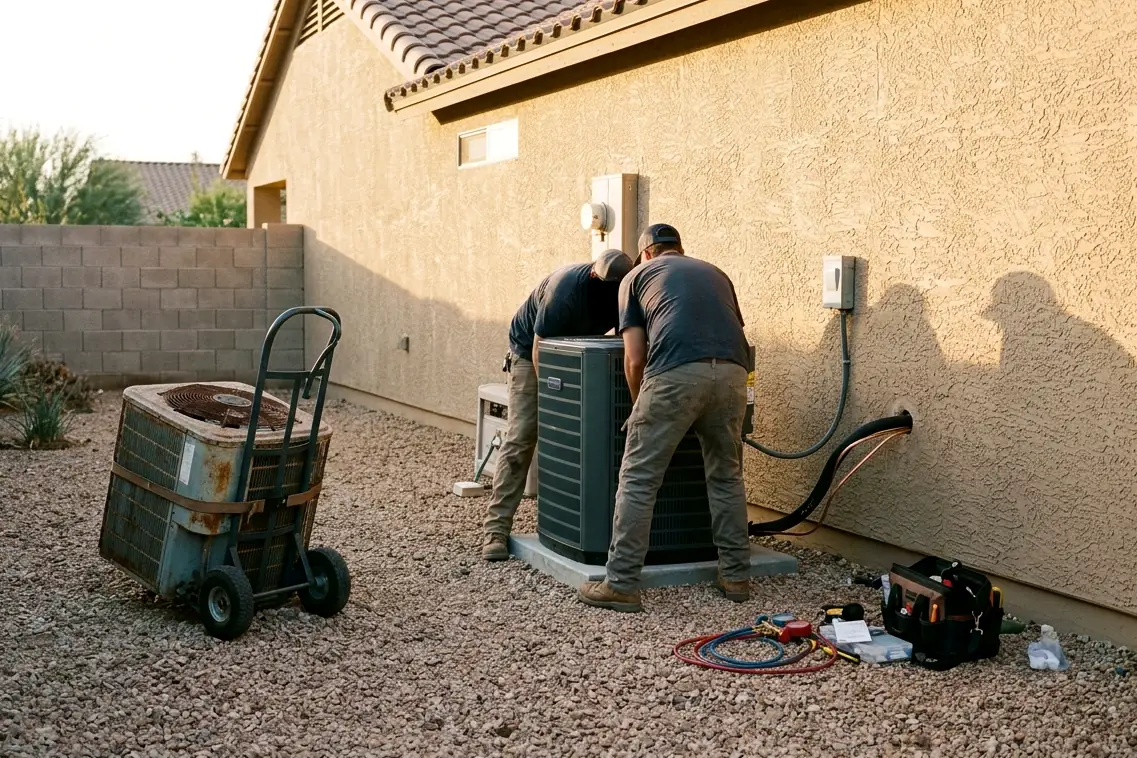
AC replacement means removing an aging or failed central air conditioner, heat pump or package unit and installing new equipment in its place, usually reusing or upgrading the existing ductwork. In Phoenix, replacement makes sense when a system is roughly 12 to 15 years old, runs on R-22, needs a compressor or coil on an older unit, or keeps breaking down every summer. A new system should be sized by load calculation, not by copying the old tonnage.
The question we hear most is simple: fix it again or replace it? There's no age where a system automatically has to go, but some signals are strong. A compressor failure on a 14-year-old unit, a large refrigerant leak on an R-22 system, or the third major repair in two summers usually tips the math toward new equipment. We put the repair cost next to the replacement cost and typical operating savings so you can see the trade-off instead of taking our word for it.
Replacement is also the moment to fix whatever the old system got wrong. Many Phoenix homes were fitted with oversized units that short cycle, or undersized ones that run all afternoon without catching up. Ducts in the attic may be leaking, crushed or poorly insulated. Returns are often too small, which strangles airflow and shortens equipment life. Before recommending a size, we run a load calculation and inspect the duct system, because new equipment on bad ducts still underperforms.
Equipment has changed in the last few years. SEER2 ratings replaced SEER in 2023, Arizona sits in the Southwest region with higher minimum efficiency rules, and systems made since 2025 use A2L refrigerants like R-454B or R-32. We install equipment from Trane, Carrier, Lennox, Goodman, Rheem, Daikin and others, and we'll explain single-stage, two-stage and variable-speed options in terms of comfort and APS or SRP bills. You'll get written options and a clear install plan.
Phoenix asks an air conditioner to run more hours than almost anywhere in the country, so efficiency differences show up on the power bill quickly. A higher SEER2 system costs more upfront, but in a home that runs cooling from April into October, the savings add up faster than in cooler regions. Variable-speed systems also handle July evenings better, running steadily at lower output instead of slamming on and off, which keeps rooms more even and removes more moisture during monsoon season.
Placement and setup matter as much as the box itself. Outdoor units here need clearance from block walls and other equipment, since recirculated hot air raises pressure and power draw. Indoor equipment in a 150-degree attic needs a sealed, well-insulated plenum, a secondary drain pan with a float switch and a clear primary drain line. We also verify the electrical circuit, replace the disconnect when it's corroded and set the refrigerant charge for the actual line length, not a factory guess.
Typical cost
Typical installed replacement system. A range, not a quote: the real number depends on what the technician finds. Full price guide
A straightforward split system swap on good ductwork sits near the low end. Larger homes, higher-efficiency variable-speed equipment, heat pumps and duct or electrical upgrades push toward the high end. These are typical Phoenix ranges, not quotes, and the real number depends on what the technician finds during the in-home inspection.
| Line item | Typical range |
|---|---|
| Split AC system replacement | $6,875 to $12,945 |
| Heat pump system replacement | $7,965 to $16,495 |
How we handle it
We look at the existing equipment, ductwork, returns, electrical and drain setup, and note any comfort complaints, so the new system fixes problems instead of inheriting them.
A load calculation based on your home's square footage, windows, insulation and orientation gives the correct capacity, which is often different from the tonnage of the old unit.
You'll see a few equipment choices with different efficiency levels and features, with typical operating cost differences for Phoenix and a written price for each option.
On install day, the crew recovers refrigerant properly, disconnects power, removes the old condenser and air handler or coil, and hauls everything away for recycling.
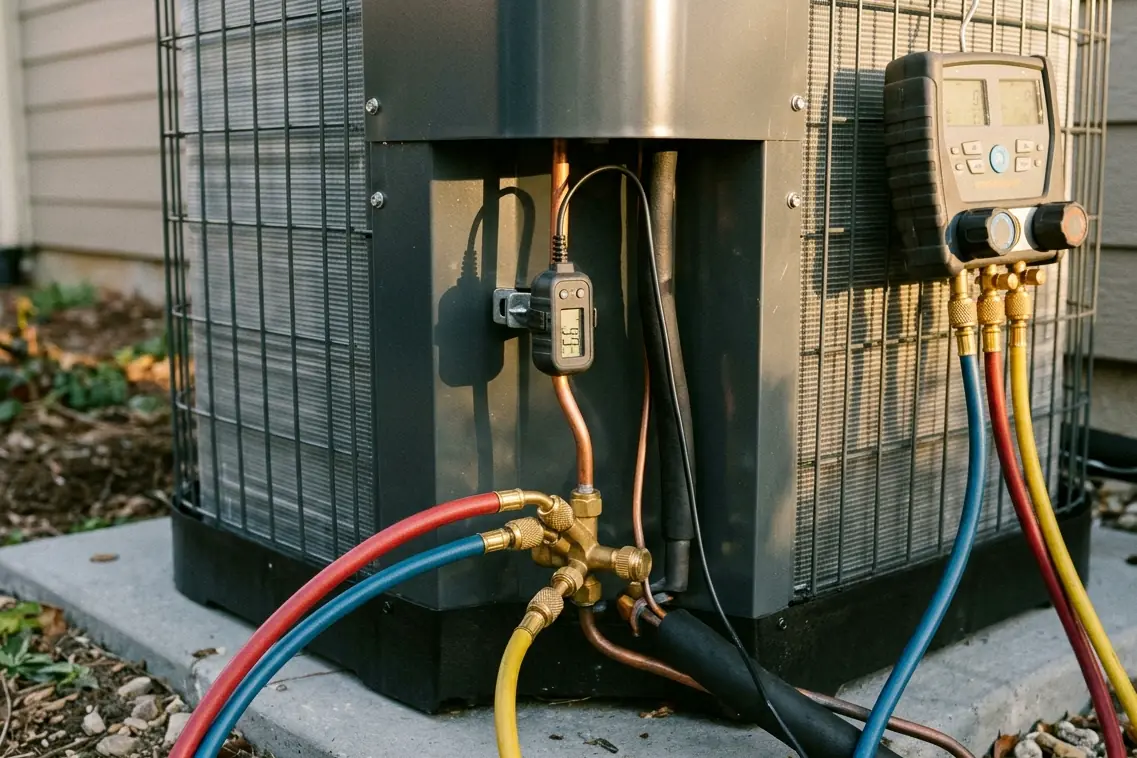
New equipment is set level, lines are flushed or replaced, brazed with nitrogen, pressure tested, evacuated and charged to the manufacturer's specs for your line length.
We verify airflow, temperature split, amp draw and drain operation, then show you the thermostat settings, the filter size and change schedule, and the registration paperwork for the manufacturer's coverage.
Signs to watch
Desert heat ages equipment faster than milder climates. Past about a dozen years, coils, compressors and fan motors start failing in clusters, and efficiency has slipped well below new equipment.
R-22 production ended in 2020, so every leak gets more expensive to recharge. Pouring scarce refrigerant into an aging system is often money better put toward replacement.
When the compressor or indoor coil fails on an older system, the repair can approach half the cost of new equipment. That's usually the clearest point to replace.
If usage is up year after year with no change in habits, the system is likely losing efficiency. Newer SEER2 equipment can cut cooling costs noticeably under time-of-use rates.
A capacitor one year, a fan motor the next and a leak after that adds up quickly. Repeated breakdowns signal a system wearing out from several directions at once.
An oversized or worn system that short cycles leaves some rooms warm and the air sticky during monsoon season. Right-sized new equipment fixes both comfort problems.
Before you call
Anything beyond these checks involves electrical parts or refrigerant, so call (602) 848-9399 and let a technician take it from there.
We repair and replace Trane, Carrier, Lennox, Goodman, Rheem, Daikin and most other makes found in Valley homes.
Related work
New central air for additions, casitas, garages and homes without ducted cooling, sized by load calculation for Phoenix summer heat.
See ac installationLoad-calculated heat pump systems with matched indoor coils, correct heat strip sizing and full commissioning, designed for 115°F summers and mild Valley winters.
See heat pump installationNew supply and return duct systems designed for your Phoenix home, with correct sizing, higher-rated insulation, sealed joints and measured airflow at every room.
See duct replacementCrane-lift rooftop and pad package unit replacements with curb adapters, electrical updates and new SEER2 gas-electric, heat pump or straight cool models.
See the serviceWhere we do this
These communities make up most of the homes we serve. Each link opens the local page with ZIP codes, typical homes and the issues we see there.
Most split system replacements take one day, usually starting early in the morning before the attic heats up. A package unit swap on the roof is also typically a one-day job if a crane isn't needed. Replacements that include new ductwork, electrical upgrades or a move from AC to heat pump can stretch to two days. We'll give you the expected schedule in advance.
If the system has failed and a repair doesn't make financial sense, replacing in summer is fine, and we do it every week from May through September. If your system still runs, spring and fall offer more scheduling flexibility and milder attic temperatures. Either way, we prioritize households without cooling when temperatures are high.
If it's cooling well and not leaking, many people keep running it. The risk is that any refrigerant leak becomes expensive because R-22 is no longer produced. Planning AC replacement before it fails lets you choose equipment calmly instead of during a July breakdown. We can inspect it and give you an honest read on its condition.
Usually not. Outdoor units and indoor coils are designed to work as matched sets, and new equipment uses different refrigerants than older systems. Mixing a new condenser with an old coil can reduce efficiency, cause performance problems and affect manufacturer coverage. In most Phoenix replacements, we replace both together for reliable operation.
Arizona's minimum is higher than in northern states, so every new system is already more efficient than older equipment. Whether to go beyond the minimum depends on your bills, how long you'll stay and your comfort goals. Because Phoenix cooling seasons are long, higher SEER2 equipment often pays back faster here. We'll show typical operating cost comparisons for your home.
Not always. Many Phoenix homes have ducts that are still in decent shape and only need sealing or a few repairs. Others, especially homes from the 1970s and 1980s, have flex duct that's crushed, torn or poorly insulated in the attic. We inspect the ducts as part of every replacement estimate and only recommend replacing them when they're holding the system back.
A real person answers (602) 848-9399 every hour of every day, and we will tell you plainly what the next step is.