Rooftop Unit Service
Spring and post-monsoon maintenance for rooftop units on homes and businesses: coil cleaning, drain flushing, belt and motor checks and electrical testing.
See rooftop unit serviceCommercial and rooftop
A planned maintenance schedule keeps rooftop units cooling through Phoenix summers and gives property managers a clear record by unit. We set visit frequency by how hard each building's equipment works.
At a glance
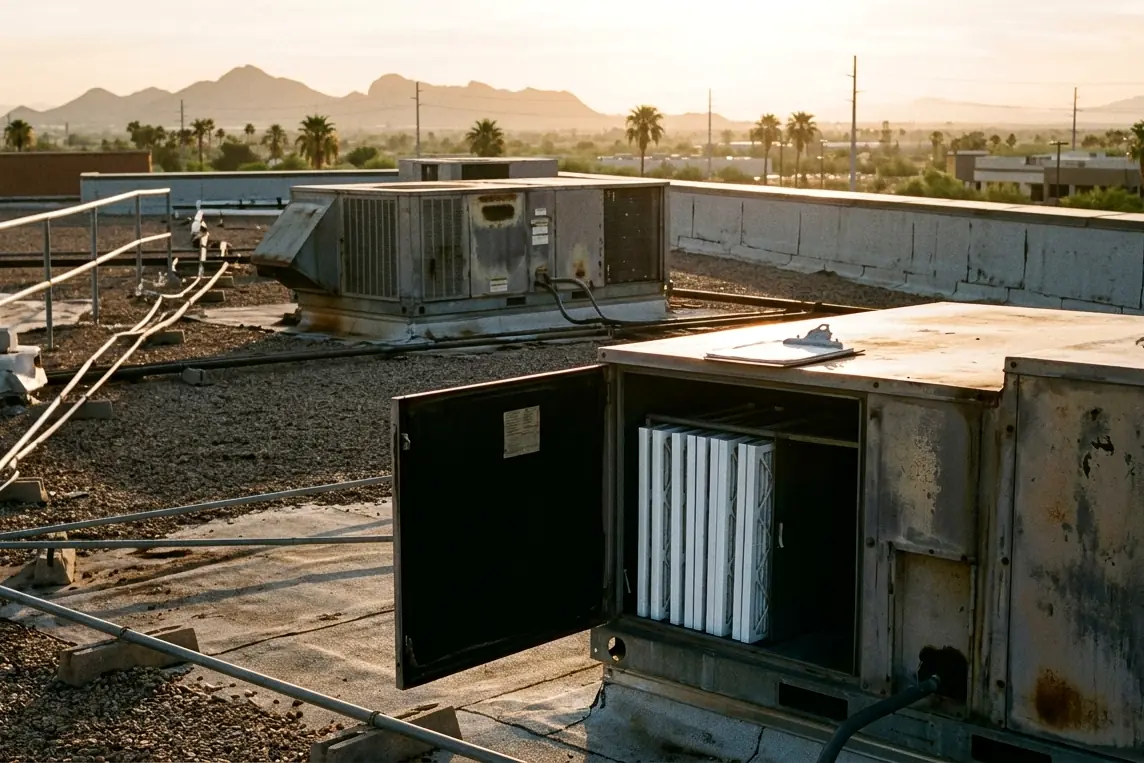
Commercial HVAC maintenance is a scheduled service program for business heating and cooling equipment: rooftop units, split systems, ductless units and make-up air units. Visits include filter changes, coil cleaning, belt checks, drain flushing, electrical testing and control checks. In Phoenix, most businesses benefit from quarterly or twice-yearly service, timed before peak heat and after monsoon season, so failures are caught early and operating costs stay steady.
Commercial equipment in Phoenix runs long hours under heavy load, and small problems compound quickly. A filter that loads up in six weeks, a belt that stretches over the summer and a drain that slowly fills with sludge all make a rooftop unit work harder before anything actually breaks. A maintenance schedule catches those early, keeps energy use steadier and gives you fewer emergency calls on the hottest days.
Our programs are built around the building rather than a one-size checklist. A small office with two split systems has different needs from a strip center with eight rooftop units or a restaurant with a make-up air unit and walk-in heat loads. We start by surveying every unit, noting age, condition and what space it serves, then recommend a visit frequency that fits how each system is used.
Every visit ends with a written report by unit: filters and belts replaced, readings taken, coil condition, drain status and any repairs recommended with priority and cost. Property managers use that record to plan budgets, answer tenant questions and decide when an aging unit should be replaced. Owners of single-location businesses get the same clarity without having to climb onto the roof themselves.
Signs to watch
If the same building calls for emergency service several times each summer, missed maintenance is often behind it. Scheduled visits shift repairs from urgent calls to planned work.
Power bills creeping up without changes in hours or occupancy can point to dirty coils, low airflow and slipping belts on rooftop units that haven't been serviced in a while.
Office and retail tenants who report hot spots or stuffy air are often responding to clogged filters, failing economizers or units that no longer hold their setpoints.
When nobody can say when filters were last changed or which unit serves which suite, a maintenance program starts with a survey that creates that record.
Restaurants exhaust grease that settles on nearby rooftop coils and filters. Units near kitchen hoods need more frequent cleaning to keep from losing capacity and drawing more power.
Older units benefit most from close monitoring. Regular readings show how fast a unit is declining, which helps plan a replacement before it fails in the middle of July.
Phoenix gives commercial HVAC a clear calendar. Spring visits in March or April prepare units for the heat: coils cleaned, belts replaced, capacitors tested and refrigerant performance checked. Summer visits, often in July for busy buildings, change filters loaded with dust and confirm drains are keeping up. After monsoon season ends September 30, a fall visit clears storm dust, checks for surge damage and readies heating sections.
Building type changes the rhythm. Restaurants and gyms with long hours and heavy internal heat usually need quarterly service, while a small professional office might do well with spring and fall visits. Buildings near desert open land or construction sites collect more dust and may need extra filter changes. We set each building's frequency based on what we see at each visit and adjust it as conditions change.
How we handle it
The technician inventories each unit: make, model, age, tonnage, filter size, belt size and the suite it serves. Photos and condition notes create a baseline record for the building.
Based on equipment age, building use and dust exposure, we recommend quarterly, twice-yearly or a mixed schedule, with clear pricing per visit and per unit before you agree to anything.
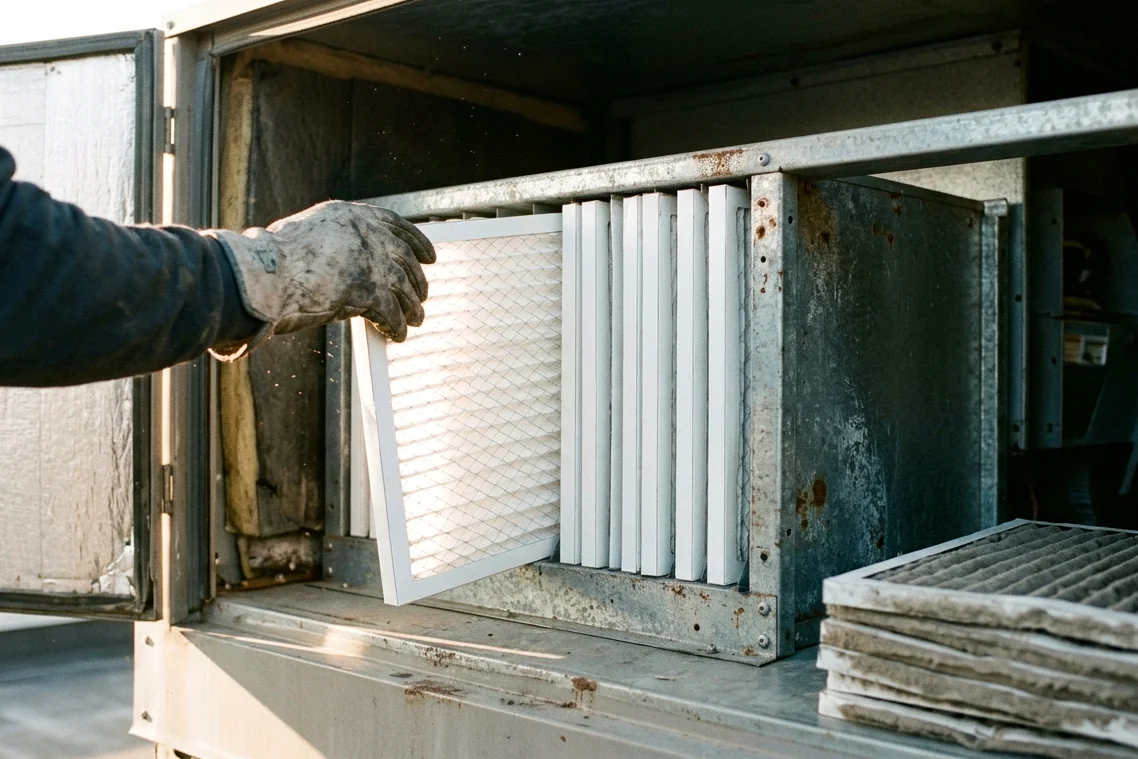
Each visit replaces filters with the correct size and rating, and inspects belts for wear and tension. Belts are replaced on schedule rather than waiting for one to snap on a hot afternoon.
Condenser coils are cleaned at least once a year, more often for dusty or grease-exposed units. Drains are flushed and pans checked so water stays off ceilings and merchandise.
Capacitors, contactors, motor amperage, economizer dampers, thermostats and building controls are all tested. Weak parts are flagged early with a repair price and a priority level.
A written report lists work done, readings and recommended repairs for every unit, so managers can track trends, plan budgets and share results with owners or tenants.
Before you call
Anything beyond these checks involves electrical parts or refrigerant, so call (602) 848-9399 and let a technician take it from there.
Typical cost
Typical per-unit maintenance visit. A range, not a quote: the real number depends on what the technician finds. Full price guide
Smaller split systems and light-commercial rooftop units sit near the low end of this per-visit range, while large RTUs with belts and economizers, or units needing coil deep cleaning, run higher. Multi-unit buildings usually get a per-unit program rate. The real number depends on what the technician finds during the site survey, and pricing is agreed before visits begin.
| Line item | Typical range |
|---|---|
| Commercial maintenance visit, split system | $185 to $325 |
| Commercial maintenance visit, rooftop unit | $235 to $465 |
| Commercial site survey and baseline report | $195 to $385 |
We repair and replace Trane, Carrier, Lennox, Goodman, Rheem, Daikin and most other makes found in Valley homes.
Related work
Spring and post-monsoon maintenance for rooftop units on homes and businesses: coil cleaning, drain flushing, belt and motor checks and electrical testing.
See rooftop unit serviceDay and night repairs for commercial rooftop units, split systems and controls on Phoenix restaurants, retail suites, offices and small warehouses.
See commercial hvac repairNew and replacement rooftop units, split systems and ductless cooling for Phoenix offices, restaurants and retail suites, sized by load calculation for the space.
See commercial installationA detailed written evaluation of equipment age, condition, ducts and safety items, useful before buying a Phoenix home or deciding on repair versus replacement.
See hvac inspectionWhere we do this
These communities make up most of the homes we serve. Each link opens the local page with ZIP codes, typical homes and the issues we see there.
Most Phoenix businesses do well with service twice a year, in spring before peak heat and in fall after monsoon season. Restaurants, gyms, medical offices and buildings with long hours often need quarterly visits. Dusty sites near open desert or construction may need extra filter changes between visits. We recommend a frequency after surveying the equipment and how the building is used.
Yes. Filter replacement is part of every maintenance visit, with filters sized and rated for each unit. In Phoenix, commercial filters can load up quickly in summer and after dust storms, so frequency matters. If your building needs filter changes more often than scheduled visits, we can add filter-only stops at a lower rate so units never run on clogged filters.
That's one of its main benefits. Reports by unit show age, condition, readings and repair history, so you can see which rooftop units are declining and plan replacements over one or two budget cycles. That's easier to present to owners than a surprise replacement in July. We can also provide summaries across several buildings if you manage more than one property.
Usually yes. Kitchen exhaust carries grease that coats nearby rooftop coils and filters, and dining rooms often run long hours with heavy internal heat. Restaurants typically need quarterly visits, more frequent filter changes and coil cleaning at most visits. Make-up air units also get checked so kitchen hoods have the replacement air they need.
The technician notes it in the report with a priority level and a repair price. Small items like a weak capacitor or worn belt are often fixed on the spot with your approval. Larger repairs get scheduled at a time that works for the business. Urgent safety items, like a gas issue or electrical hazard, are reported to you right away.
Yes. Many restaurants, medical offices and retail businesses prefer early morning or after-hours service so units can be shut down without affecting customers or patients. We schedule around your operating hours when possible. Early mornings also help in summer, since roof temperatures are lower and technicians can work more efficiently.
A real person answers (602) 848-9399 every hour of every day, and we will tell you plainly what the next step is.