AC Repair
Warm air, odd noises or a system that never shuts off. We test capacitors, refrigerant, airflow and controls, then fix the real cause.
See ac repairAc parts and repairs
Capacitors and contactors are small, inexpensive parts, and they cause more Phoenix summer breakdowns than anything else. We test them with a meter and replace failing ones on the spot.
At a glance
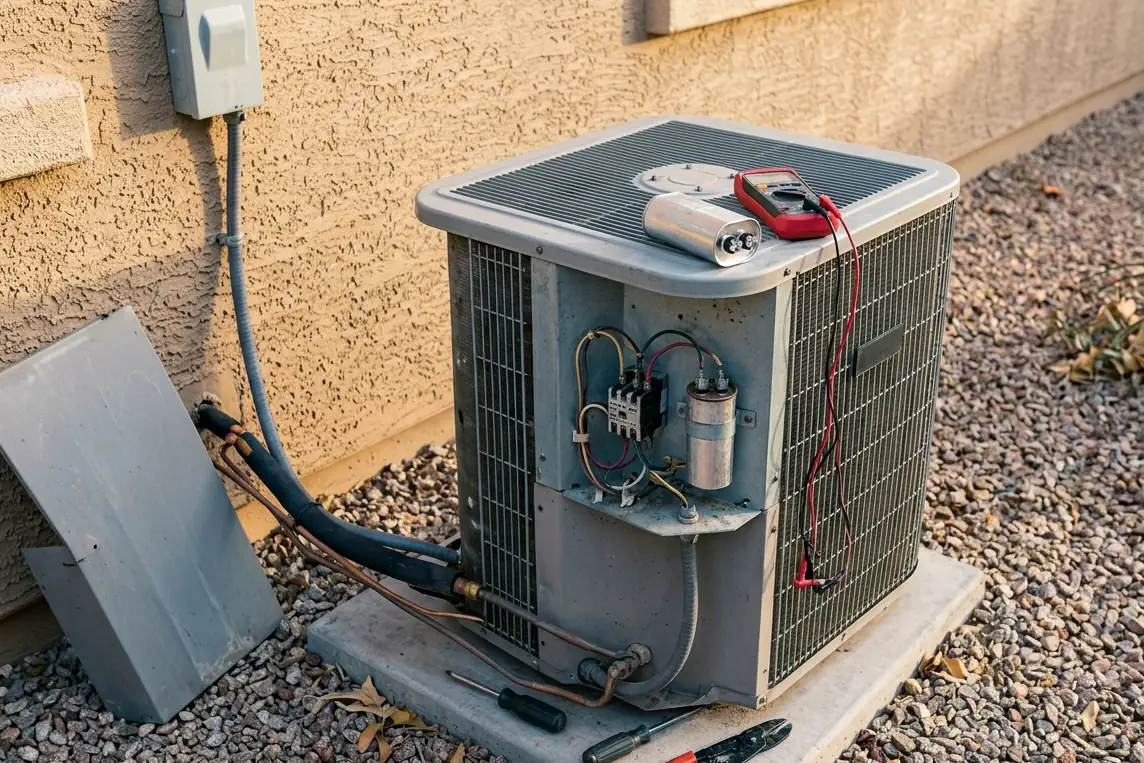
Capacitor and contactor replacement swaps out the electrical parts that start and power your AC's compressor and fan motors. The capacitor stores a charge that gives motors their starting kick; the contactor is the switch that sends high voltage to the outdoor unit when the thermostat calls. In Phoenix, heat and monsoon power surges wear both parts quickly. Signs include humming without the fan spinning, clicking, or a unit that won't start at all.
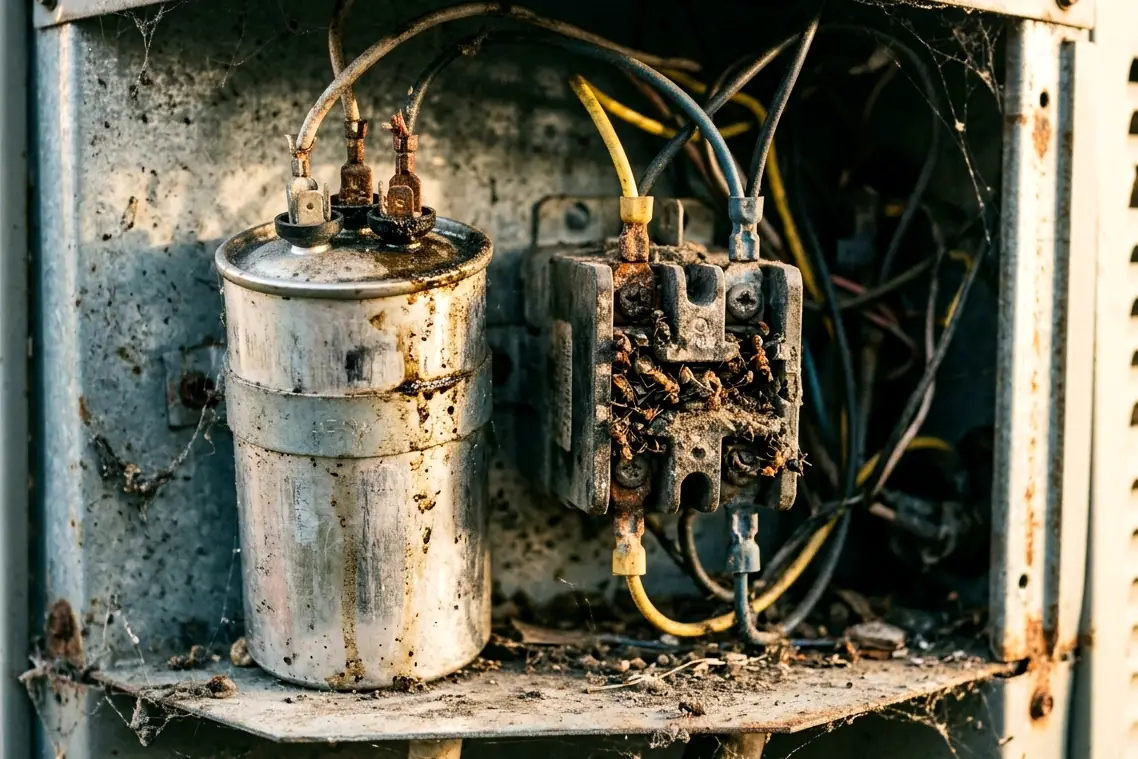
Inside your outdoor unit, the run capacitor looks like a metal can, usually silver, with two or three terminals on top. It stores energy and releases it to help the compressor and fan motor start and run efficiently. Over time, heat breaks down the capacitor's internal materials and its capacity, measured in microfarads, drops. Once it falls too far below its rating, motors struggle to start, run hot and draw extra current. Eventually the capacitor fails completely and the system stops cooling.
The contactor is a switch that closes when your thermostat calls for cooling, sending 240 volts to the compressor and outdoor fan. Every time it closes, a small arc forms across its contact points. Over thousands of cycles, those points pit, burn and can stick closed or fail to close. Ants and other insects sometimes nest inside contactors, attracted by the electrical field, and their bodies can block the contacts. A failing contactor may cause clicking, chattering or a unit that won't start.
Testing is quick and decisive. With power off and the capacitor discharged, we measure microfarads against the rated value printed on the can. A reading more than about 5 to 10 percent low usually means replacement. We inspect the contactor for pitting, burn marks and insect debris, and check voltage across its contacts. Because these parts are so common, our trucks carry many sizes, and most replacements happen during the same visit.
Signs to watch
A hum from the outdoor unit with a still fan blade usually means the capacitor can't give the motor its starting push. Turn the system off to protect the compressor from overheating.
If the outdoor fan only starts after someone pushes the blade, the fan's capacitor is weak or failed. Don't keep doing this; call for a replacement instead.
Clicking or chattering at the outdoor unit without the compressor starting can mean a failing contactor that can't stay closed or isn't making good contact.
A swollen top or oily residue on the capacitor can indicate internal failure. Even if the system still runs, a bulging capacitor is near the end of its life.
If the outdoor unit keeps running after the thermostat is satisfied or turned off, the contactor may be stuck closed and needs replacement before it damages equipment.
Monsoon power surges often damage capacitors and contactors. If the AC stopped after a storm, these parts are among the first we test.
Before you call
Anything beyond these checks involves electrical parts or refrigerant, so call (602) 848-9399 and let a technician take it from there.
How we handle it
We turn off the outdoor disconnect, confirm no voltage is present and safely discharge the capacitor before handling it, since capacitors can hold a charge after power is removed.
Using a meter, we measure each capacitor's microfarad reading and compare it with the rating on its label. Readings well below the rating indicate a weak capacitor.
We look for pitted or burned contact points, melted plastic, insect debris and loose wiring, and check voltage across the contactor with the system running.
A capacitor can fail because a motor is failing. We check compressor and fan motor amp draw so the new capacitor isn't paired with a motor about to fail.
New capacitors match the microfarad and voltage ratings required by the equipment, and contactors match the voltage and amp ratings, with secure connections and clean terminals.
After replacement, we restore power, start the system and verify that motors start quickly, run smoothly and draw normal current, then confirm cooling at the vents.
Typical cost
Typical capacitor or contactor replacement visit. A range, not a quote: the real number depends on what the technician finds. Full price guide
A single run capacitor replacement during a regular visit sits near the low end. Replacing both a dual capacitor and contactor, adding a hard-start kit, or after-hours service pushes costs higher. These are typical Phoenix ranges, not quotes, and the real number depends on what the technician finds when testing the electrical components and motors.
| Line item | Typical range |
|---|---|
| Dual run capacitor replacement | $165 to $365 |
| Hard-start kit installation | $185 to $395 |
Capacitors are the most common summer failure part in Phoenix, and heat is the main reason. Outdoor units sit in direct sun with ambient temperatures well above 105 degrees, and the inside of the cabinet runs even hotter. Heat accelerates the breakdown of a capacitor's internal materials, so a capacitor that might last many years in a mild climate can fail much sooner here. Long run times add stress, since the capacitor works whenever the compressor and fan run.
Monsoon season adds electrical stress. Storms bring power flickers and surges that can damage capacitors and burn contactor points. When power drops and returns rapidly, motors may restart under load, pulling extra current through these parts. Dust that collects inside the unit can also hold heat around components. Testing capacitors and inspecting contactors during spring tune-ups catches many weak parts before they fail in July, when an outage is hardest to tolerate.
We repair and replace Trane, Carrier, Lennox, Goodman, Rheem, Daikin and most other makes found in Valley homes.
Related work
Warm air, odd noises or a system that never shuts off. We test capacitors, refrigerant, airflow and controls, then fix the real cause.
See ac repairNights, weekends and holidays, a person answers and a technician rolls with capacitors, contactors and motors on board to restore cooling fast.
See emergency ac repairOutdoor fan motors that stall, squeal or overheat repaired or replaced with correct horsepower, rotation and capacitor to protect the compressor.
See condenser fan motorConfirmed compressor failures replaced with matched parts, flushed lines and a fresh charge, or an honest comparison with a new system.
See compressor replacementWhere we do this
These communities make up most of the homes we serve. Each link opens the local page with ZIP codes, typical homes and the issues we see there.
Common signs include a humming outdoor unit with a fan that won't spin, a fan that starts only when nudged, clicking without startup, or a bulging capacitor. A technician confirms it by measuring microfarads against the rated value. In Phoenix, capacitors fail often in summer, so they're one of the first things we check.
Capacitor life varies by quality, heat exposure and electrical conditions. In Phoenix, many capacitors fail sooner than they would in milder climates because outdoor units sit in direct sun and run long hours. Monsoon surges can shorten their life further. Testing during spring tune-ups helps catch weak capacitors before they fail during peak summer.
We don't recommend it. Capacitors can store a dangerous electrical charge even after power is off, and the wrong rating can damage motors. Contactors handle 240 volts. A technician also checks why the part failed, such as a failing motor. For safety and reliable repair, it's best to have a trained technician do the work.
The capacitor stores and releases energy to help the compressor and fan motors start and run efficiently. The contactor is an electrical switch that closes when the thermostat calls for cooling, sending high voltage to the outdoor unit. Both are common failure points, and we often test them together during service calls.
Ants are attracted to electrical fields and often crawl into contactors. When they get between the contacts, they can be crushed and block the connection, preventing the unit from starting. In some Phoenix neighborhoods, this is a common cause of contactor failure. Keeping the area around the unit clear and treating ant activity nearby can help.
A hard-start kit helps older or struggling compressors start more easily, reducing strain and electrical draw at startup. It can be helpful for compressors that hesitate or trip breakers when starting. We'll check compressor startup and amp draw and recommend a hard-start kit only when it's likely to help.
A real person answers (602) 848-9399 every hour of every day, and we will tell you plainly what the next step is.