Emergency AC Repair
Nights, weekends and holidays, a person answers and a technician rolls with capacitors, contactors and motors on board to restore cooling fast.
See emergency ac repairAir conditioning
When your air conditioner quits in a Phoenix summer, the house can climb past 90 degrees in a few hours. We find the actual fault, explain it plainly and fix it on the same visit whenever the part is on the truck.
At a glance
AC repair means diagnosing and fixing a central air conditioner, heat pump or package unit that has stopped cooling, cools weakly, makes new noises or trips breakers. In Phoenix you need it the moment the system can't hold about 20 degrees below the outdoor temperature, runs nonstop without catching up, or shows ice on the lines. Common culprits here are failed capacitors, worn contactors, dirty coils, low refrigerant and clogged drain lines.
Most AC breakdowns in the Valley come down to a short list of parts working under heat they were never comfortable with. A run capacitor that tested fine in April can bulge by July. A contactor pitted by monsoon power flickers stops pulling in. A condenser coil packed with dust after a haboob pushes head pressure so high the compressor trips on overload. Our technicians start with those likely suspects, but we test rather than guess, because swapping parts until something works only runs up your bill.
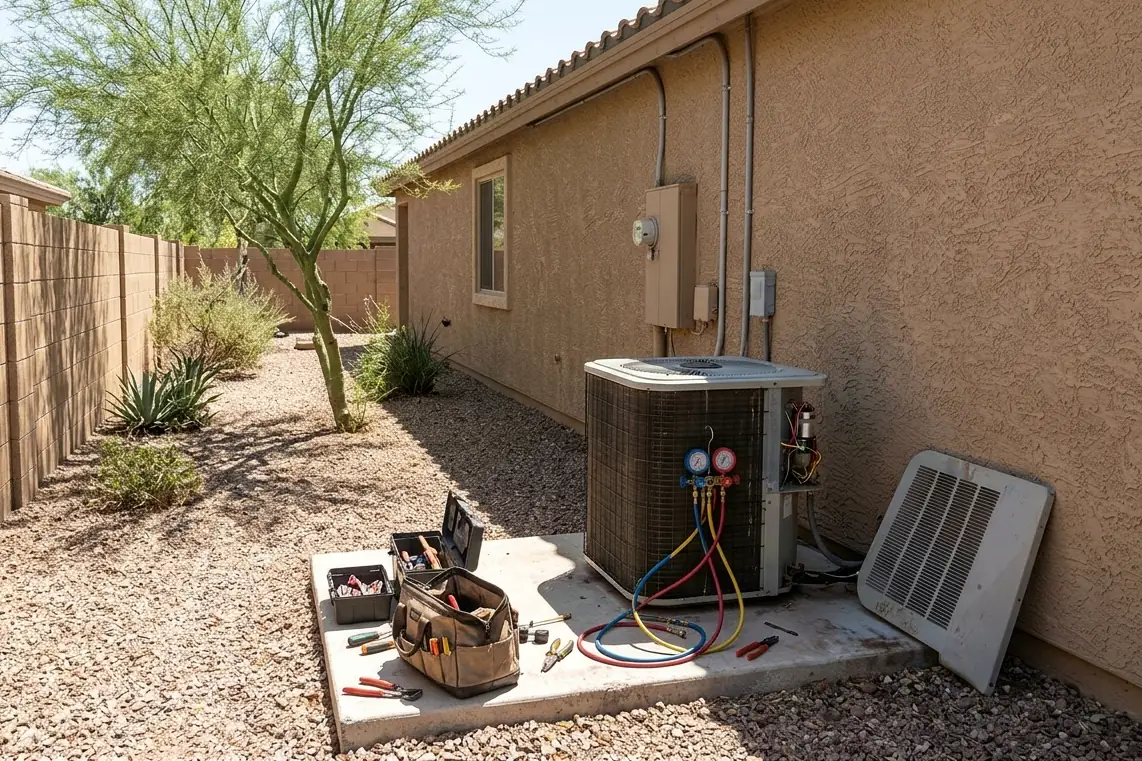
A proper repair visit begins at the thermostat and ends at the supply registers. We check voltage at the disconnect, amp draw on the compressor and fan motors, refrigerant pressures and superheat or subcooling, and the temperature split across the indoor coil. We also look at the filter, the blower wheel and the condensate drain. That full picture tells us whether the problem is a single failed part or a sign that something upstream, like poor airflow, is killing parts early.
Before any work starts, you'll get a clear explanation of what failed, why it likely failed and what it costs to fix. If the repair makes sense, most visits wrap up the same day, since we stock common capacitors, contactors, fan motors and fuses. If your system is old, runs on R-22 or needs a repair that rivals the cost of new equipment, we'll say so and show you the numbers. You decide, and you can call (602) 848-9399 any hour to get started.
Signs to watch
If the registers feel barely cooler than the room, the compressor may not be running, the refrigerant charge could be low, or the outdoor fan may have stopped moving air across the coil.
Running all afternoon is normal at 112 degrees, but a thermostat that keeps drifting up after sunset points to weak capacity, dirty coils or a failing part that needs attention.
A loud hum from the condenser while the fan blade sits still usually means a weak capacitor or seized fan motor. Shut the system off so the compressor doesn't overheat.
Frost on the larger suction line or the indoor coil usually signals low airflow or low refrigerant. Running it iced over can flood the compressor with liquid, so switch to fan only.
In attic installs, a clogged condensate line or rusted secondary pan can overflow and spot the drywall below the air handler. Catching it early keeps the damage small.
A breaker that pops right as the compressor kicks on can mean a shorted compressor winding, a failing hard-start circuit or a loose, overheated connection that needs testing with a meter.
Before you call
Anything beyond these checks involves electrical parts or refrigerant, so call (602) 848-9399 and let a technician take it from there.
How we handle it
We start by asking what you noticed, when it started and whether anything changed, like a storm, a power outage or a new filter. Those details often point straight at the failed component.
Our technician confirms the thermostat is calling, then checks voltage at the disconnect, the low-voltage control circuit, the float switch and the contactor before touching anything bigger.
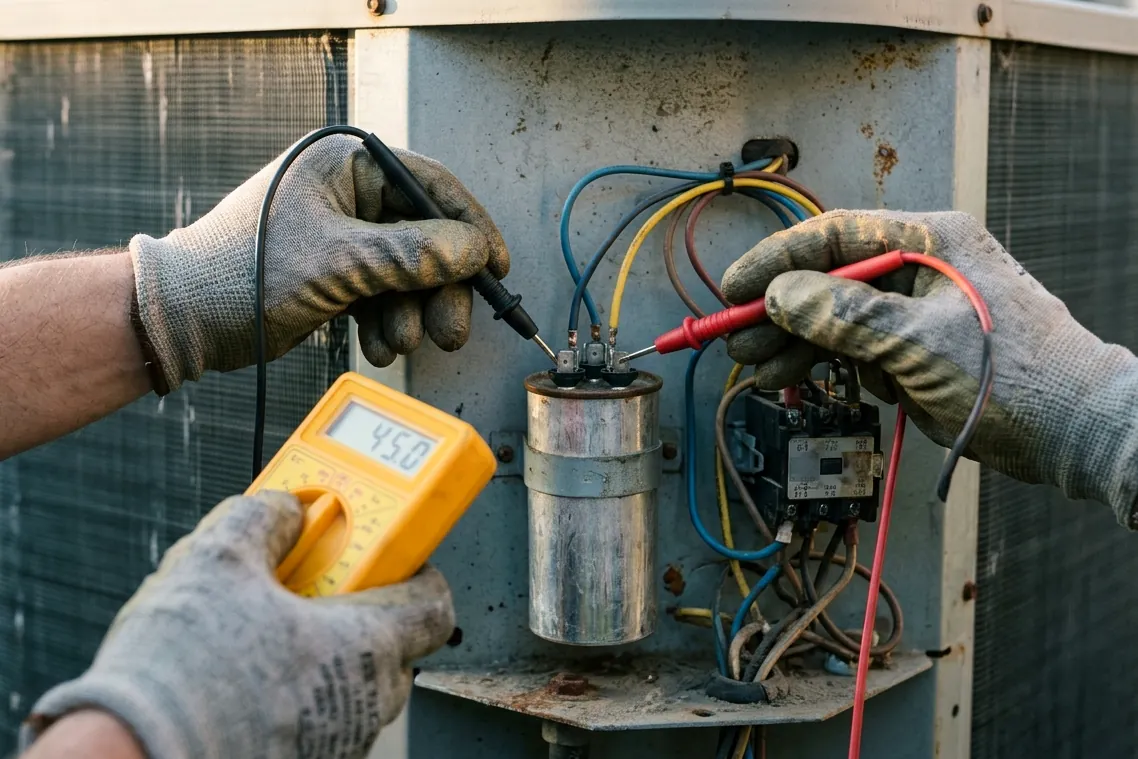
Capacitors get tested with a meter against their rated microfarads, motors get amp-checked, and the condenser coil gets a close look for dust packing, bent fins and debris.
Gauges and temperature probes show pressures, superheat and subcooling. Combined with the indoor temperature split, those readings separate a charge problem from an airflow problem or a failing compressor.
You'll hear what failed, why it likely failed and what the repair costs, in plain words. Nothing gets replaced until you say yes to the work and the number.
After the repair, we run the system, recheck amps and pressures, confirm a healthy temperature split and make sure the drain is flowing before we pack up.
Typical cost
Typical repair visit, parts and labor. A range, not a quote: the real number depends on what the technician finds. Full price guide
Most Phoenix AC repairs land at the lower end, since capacitors, contactors and drain clears are quick fixes with parts we carry. Motor replacements and leak work cost more, and compressor or coil jobs sit on their own pages. These are typical ranges, not quotes; the real number depends on what the technician finds once the system is tested.
| Line item | Typical range |
|---|---|
| Diagnostic service call | $89 to $149 |
| Run capacitor replacement | $145 to $335 |
| Contactor replacement | $165 to $345 |
Few places ask more of an air conditioner than the Valley. Afternoon highs routinely sit between 105 and 115 degrees from June through August, and July nights often stay in the upper 80s or above 90. That means your system may run almost around the clock for weeks, with little cool night air to let it rest. Electrical parts like capacitors and contactors break down faster under constant heat, which is why they top our list of summer repairs.
Location makes it harder. Many Phoenix air handlers and ducts sit in attics that reach roughly 140 to 160 degrees, so blower motors and control boards bake all summer. Rooftop package units on older homes take direct sun all day. Monsoon season, from mid June to the end of September, adds dust that clogs coils and power surges that fry weak components. A repair here has to account for those conditions, or the same part fails again.
Two-thermometer test
Hold a thermometer at a return grille, then at the supply register nearest the air handler after the AC has run 15 minutes.
Inside the normal range
A 15 to 22°F split points to a coil and charge doing their job.
Not sure? Call (602) 848-9399.
We repair and replace Trane, Carrier, Lennox, Goodman, Rheem, Daikin and most other makes found in Valley homes.
Related work
Nights, weekends and holidays, a person answers and a technician rolls with capacitors, contactors and motors on board to restore cooling fast.
See emergency ac repairThe most common Valley summer failure: weak capacitors and pitted contactors tested with a meter and replaced from stock on the truck.
See capacitors & contactorsElectronic and dye leak detection, brazed or replaced parts, nitrogen pressure tests and a proper vacuum and recharge so the charge stays put.
See refrigerant leak repairCapacitor tests, coil cleaning, drain flushing and refrigerant readings that catch weak parts in spring, before Phoenix summer heat finds them.
See ac tune-upWhere we do this
These communities make up most of the homes we serve. Each link opens the local page with ZIP codes, typical homes and the issues we see there.
We answer (602) 848-9399 every hour of every day, and in summer we route technicians to no-cooling calls first. Most Phoenix and nearby Valley homes get a visit the same day you call, often within a few hours. If someone in the home is elderly, very young or medically fragile, tell us when you call so we can weigh that when we plan the route.
It can be. Most residential systems are designed to hold roughly 20 degrees below the outdoor temperature on the hottest days, so 78 to 82 degrees inside at 115 outside may be normal operation. If the house keeps climbing after sunset, or the air from the vents is less than about 15 degrees cooler than the return air, something likely needs repair.
Heat is the main enemy of capacitors, and outdoor units here sit in direct sun at 110 degrees or more. Power surges during monsoon storms add stress, and an undersized or low-quality replacement part wears out faster. A failing fan motor can also overwork the capacitor. During an AC repair, we check the motor and wiring so the new capacitor isn't set up to fail.
If you see ice on the lines, hear a loud hum with no fan turning or smell burning, turn the system off at the thermostat. Running it in those conditions can ruin the compressor, turning a modest repair into a major one. If it's simply cooling weakly with no noise or ice, running it is usually fine until our technician arrives.
Yes. We repair R-22 systems all the time, and most electrical and airflow repairs on them cost the same as on newer units. Refrigerant is the exception: R-22 is no longer produced, so recharging is expensive. If an older system needs a large refrigerant charge, we'll show you the repair price next to a replacement estimate so you can compare.
We repair the equipment found across Phoenix homes, including Trane, Carrier, Lennox, Goodman, Rheem, Ruud, American Standard, Daikin, Bryant, York, Amana and Heil, plus ductless systems from Mitsubishi Electric and Fujitsu. Universal parts like capacitors and contactors ride on our trucks. Brand-specific control boards or motors may need ordering, and we'll tell you the expected timing up front.
A real person answers (602) 848-9399 every hour of every day, and we will tell you plainly what the next step is.