Evaporator Coil Replacement
Leaking or corroded indoor coils replaced with matched units, brazed, pressure tested, evacuated and charged for reliable cooling.
See evaporator coilAc parts and repairs
If your system keeps needing refrigerant, it has a leak. Topping it off every summer only buys time. We track down where the refrigerant is escaping and fix it, so the charge stays put.
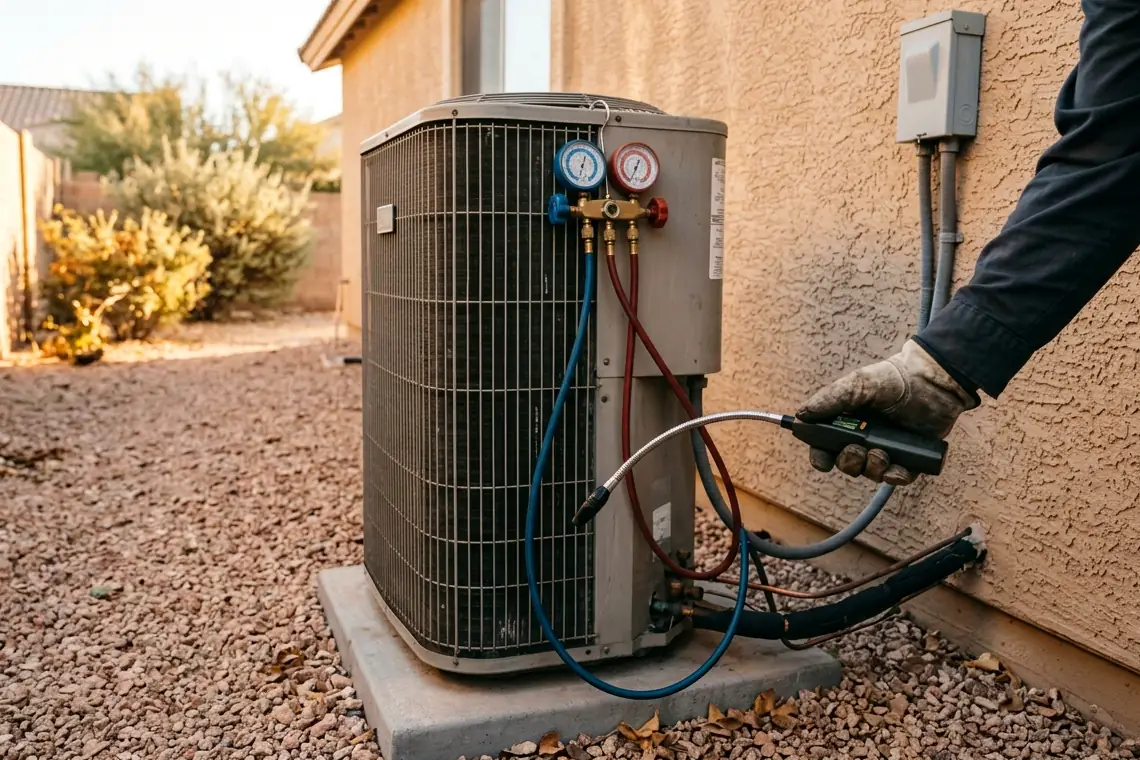
At a glance
Refrigerant leak repair is finding and fixing the spot where refrigerant escapes from your air conditioner or heat pump, then restoring the correct charge. In Phoenix, leaks show up as weak cooling, ice on lines, long run times and rising bills. Common leak points include evaporator coils, flare and Schrader fittings, rubbed copper lines and condenser coils. A proper repair includes leak detection, repair, pressure testing, evacuation and recharge to the manufacturer's specification.
Refrigerant isn't used up like fuel. An air conditioner circulates the same charge for its entire life unless there's a leak. So when a system is low, adding refrigerant without finding the leak just means it'll be low again, sometimes in weeks, sometimes next summer. Meanwhile, low charge forces the compressor to run longer with less cooling, and it can overheat. Fixing the leak protects the most expensive part of your system and keeps cooling steady through the hottest months.
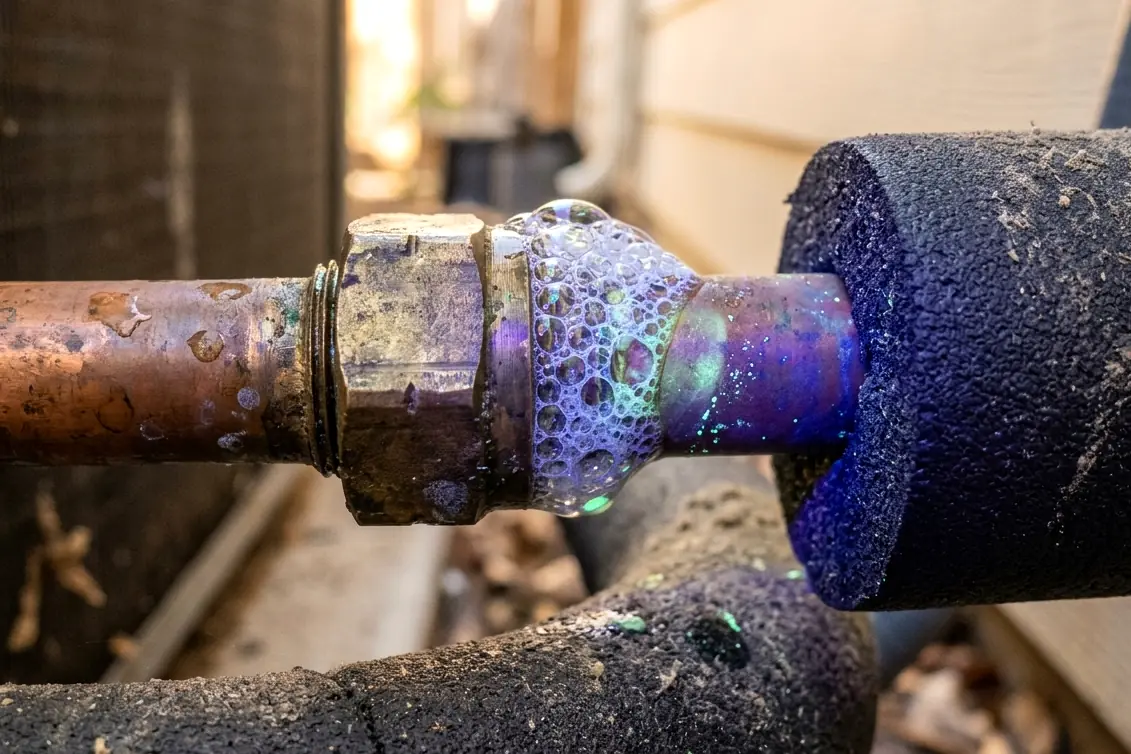
Finding a leak takes method. We start with pressure readings and superheat or subcooling to confirm low charge, then look for oil stains at fittings, valves and coils, since refrigerant carries oil as it escapes. Electronic leak detectors sniff along lines and coil surfaces, and soap bubbles confirm suspicious spots. For slow leaks, UV dye can be added and checked after the system runs. Sometimes we isolate sections and pressure test with nitrogen to find which part is leaking.
Once the leak is located, repair depends on where it is. A loose flare fitting or leaking Schrader valve core can often be fixed in a single visit. A rubbed copper line can be cut out and brazed with a new section. Pinhole leaks in an evaporator or condenser coil are harder: some can be repaired, but many coils need replacement. After any repair, we pressure test, pull a deep vacuum and weigh in the correct charge.
Signs to watch
A system that cooled fine last summer but slowly lost ground often has a slow leak. As charge drops, the indoor coil can't absorb as much heat from your home's air.
Low refrigerant drops coil pressure and temperature, so moisture on the larger copper line or indoor coil turns to ice. Switch to fan only and call before the compressor is damaged.
A faint hiss near the indoor or outdoor unit, or a gurgling sound in the lines, can mean refrigerant escaping from a larger leak or a cracked fitting.
Refrigerant carries compressor oil with it, so oily residue at valves, flare nuts or coil joints often marks the leak location. Dust sticks to the oil and darkens it.
If a technician added refrigerant last summer and the system is low again, the leak was never found. Another top-off without repair only repeats the cycle.
Low charge makes the system run longer to move the same heat. A jump in APS or SRP usage with similar weather can point to a slow leak.
Before you call
Anything beyond these checks involves electrical parts or refrigerant, so call (602) 848-9399 and let a technician take it from there.
How we handle it
Gauges, temperature probes and superheat or subcooling readings confirm the system is actually low, ruling out airflow problems or a dirty coil that can mimic low charge.
We inspect fittings, valves and coils for oil stains, then use an electronic leak detector and soap bubbles. UV dye may be added for slow or hidden leaks.
For stubborn leaks, we recover refrigerant and pressurize sections with dry nitrogen, which helps pinpoint whether the coil, the line set or a fitting is leaking.
You'll hear exactly where the leak is, how it can be repaired and what each option costs, including coil replacement when a repair isn't practical.
We tighten or replace fittings, braze in new copper sections or replace parts, then hold nitrogen pressure to confirm the repair is tight before moving on.
A deep vacuum removes moisture and air, then the correct charge is weighed in and verified with superheat or subcooling readings under real operating conditions.
Typical cost
Typical leak search, repair and recharge. A range, not a quote: the real number depends on what the technician finds. Full price guide
A leaking valve core or loose flare fitting with a modest recharge sits near the low end. Brazed line repairs fall in the middle, while large R-22 recharges and coil-related repairs push toward the high end. These are typical Phoenix ranges, not quotes; the real number depends on what the technician finds during leak detection.
| Line item | Typical range |
|---|---|
| Refrigerant leak search | $185 to $465 |
| Line set leak repair and recharge | $395 to $1,135 |
Heat and vibration work against refrigerant lines in the Valley. Outdoor units run thousands of hours a year, and constant compressor vibration can rub copper lines against each other, the cabinet or a wall bracket until a pinhole wears through. Large daily temperature swings in spring and fall expand and contract fittings, loosening flare nuts on mini-splits and some older equipment. Rooftop package units and attic coils face extreme heat that ages rubber seals and valve cores.
Refrigerant type affects the decision after a leak. Systems on R-22, which stopped being produced in 2020, cost much more to recharge, so a large leak on an older system may tip the decision toward replacement. Systems on R-410A are more affordable to recharge but still deserve a proper repair. Newer equipment uses A2L refrigerants like R-454B, which require specific handling. We'll explain the repair and recharge cost for your refrigerant type before work begins.
Two-thermometer test
Hold a thermometer at a return grille, then at the supply register nearest the air handler after the AC has run 15 minutes.
Inside the normal range
A 15 to 22°F split points to a coil and charge doing their job.
Not sure? Call (602) 848-9399.
We repair and replace Trane, Carrier, Lennox, Goodman, Rheem, Daikin and most other makes found in Valley homes.
Related work
Leaking or corroded indoor coils replaced with matched units, brazed, pressure tested, evacuated and charged for reliable cooling.
See evaporator coilWarm air, odd noises or a system that never shuts off. We test capacitors, refrigerant, airflow and controls, then fix the real cause.
See ac repairConfirmed compressor failures replaced with matched parts, flushed lines and a fresh charge, or an honest comparison with a new system.
See compressor replacementError codes, dripping heads or weak cooling on a ductless system? We repair inverter boards, sensors, condensate drains, fan motors and flare leaks on mini-splits.
See mini-split repairWhere we do this
These communities make up most of the homes we serve. Each link opens the local page with ZIP codes, typical homes and the issues we see there.
Common signs include weak cooling that gets worse over time, ice on the larger copper line or indoor coil, hissing near the units, oily stains on fittings and a system that needed refrigerant before. A technician confirms it with pressure and temperature readings. Low charge never fixes itself, so finding the leak is the only lasting solution.
We can add refrigerant to get you cooling in an emergency, but it's a short-term fix. The refrigerant will keep escaping, and running low strains the compressor. Repeated top-offs also cost more over time than a proper repair, especially on R-22 systems. We'll explain the repair options so you can choose a lasting fix.
A leak at a fitting or valve core can often be found and repaired in two to three hours, including vacuum and recharge. Hidden or slow leaks may need UV dye and a follow-up visit after the system runs for a few days. Brazed line repairs and coil replacements take longer and may require ordering parts.
It depends on the system's age and how much refrigerant it needs. A small leak at a fitting on an otherwise healthy system may be worth fixing. A large coil leak on a 15-year-old R-22 system usually isn't, because R-22 is expensive and the system is near the end of its life. We'll compare repair and replacement costs for you.
Refrigerant leaks in homes are usually slow and disperse quickly, so they rarely pose an immediate health risk in normal living spaces. However, refrigerant in an enclosed space can displace oxygen, and touching escaping refrigerant can cause frostbite. If you hear a loud hiss or notice a strong chemical smell, ventilate the area, shut the system off and call us.
Flare connections on ductless systems can loosen over time from temperature swings and vibration, especially if they weren't torqued correctly during installation. Phoenix's large day-to-night temperature changes in spring and fall add stress. We remake leaking flares with proper tools and torque specs, and pressure test before recharging, so the repair holds.
A real person answers (602) 848-9399 every hour of every day, and we will tell you plainly what the next step is.