Air Handler Repair
Indoor unit misbehaving? We repair air handler control boards, relays, transformers, drain pans, float switches and wiring in attics, closets and garages across Phoenix.
See air handler repairAc parts and repairs
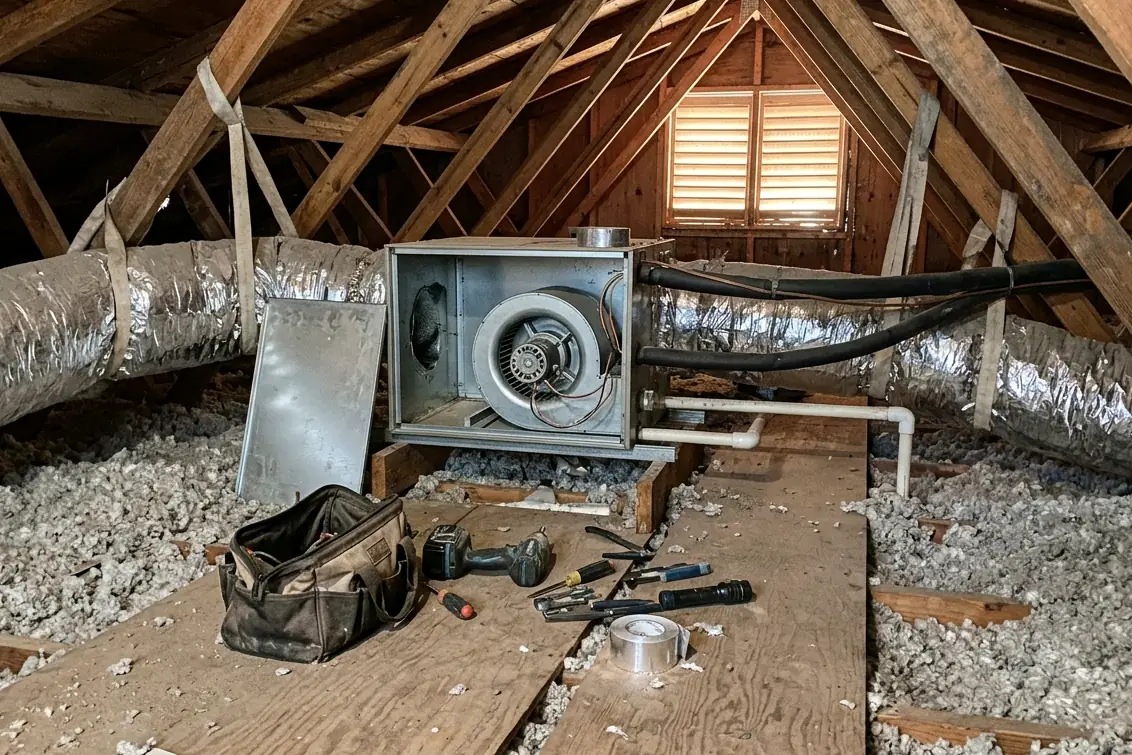
When the outdoor unit runs but almost no air reaches your vents, the blower is usually the reason. Our technicians test the motor, capacitor, control board and wheel so you know exactly which part failed.
At a glance
Blower motor repair restores the fan inside your air handler or furnace that pushes cooled or heated air through the ducts. In Phoenix you need it when the condenser outside is running but the vents barely move air, the indoor unit hums without spinning, or you smell hot wiring near the air handler. Attic heat wears these motors fast, so a weak or dead blower is a common midsummer call for us.
The blower is the fan that moves every cubic foot of air your system conditions. If it slows down or stops, the evaporative coil gets no warm air across it, the refrigerant stays too cold, and the coil can ice over within an hour. Meanwhile the condenser outside keeps running, burning power while your rooms creep toward the outdoor temperature. That combination is why a blower problem feels like a total AC failure even though the compressor is fine.
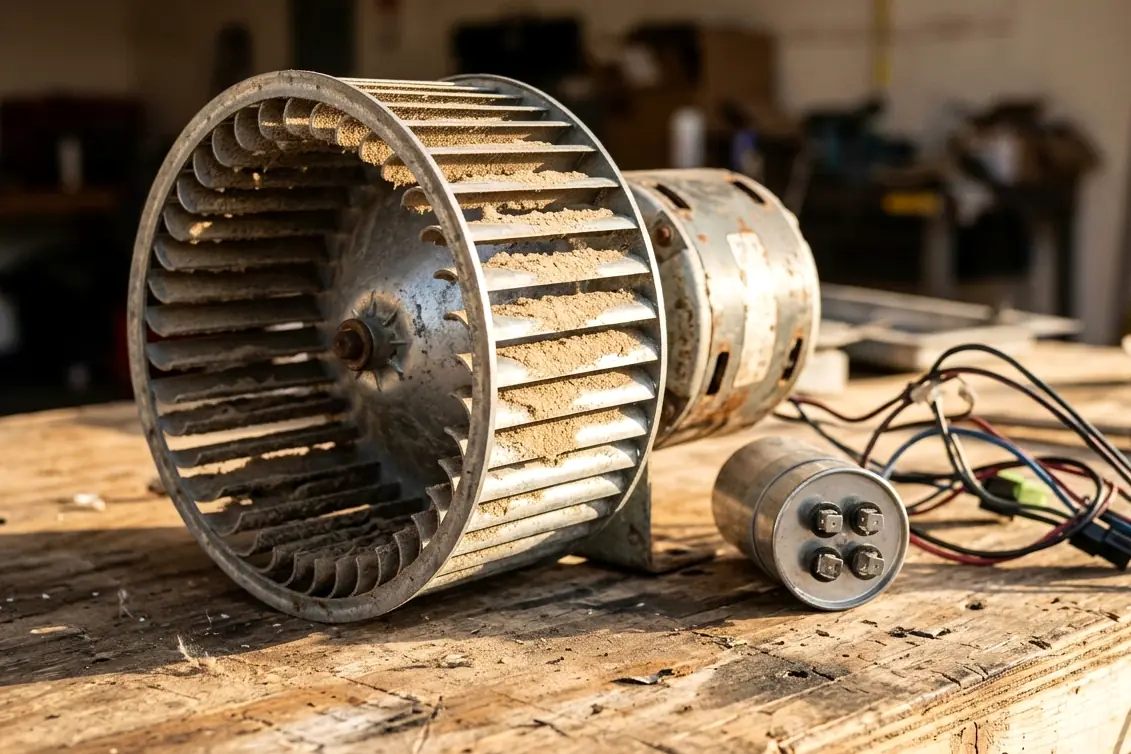
Most Valley homes have one of two motor types. Older systems use a PSC motor with a separate run capacitor, which is cheap to diagnose and often fixable by swapping the capacitor. Newer variable-speed and constant-torque systems use an ECM motor with an electronic module bolted to the back. Those modules can fail on their own, so a careful technician tests the module and the motor separately before recommending the more expensive piece.
Our approach is simple: confirm what failed, show you the reading, and give you the price before any part goes in. We carry common PSC motors, universal capacitors and several ECM modules on the truck, so many repairs finish the same day. When a motor is specific to one manufacturer, we tell you how long the part takes and help you keep the house tolerable in the meantime.
Signs to watch
The condenser fan spins and the compressor hums, yet the registers inside push only a faint breeze. That split points straight at the indoor fan rather than the refrigerant side.
A motor that hums but will not turn usually has a failed run capacitor, seized bearings or a locked wheel. Leaving it energized can overheat the windings within minutes.
A burning or hot varnish odor at the attic hatch or closet often means motor windings are cooking. Turn the system off at the thermostat and call before running it again.
Frost on the large copper line or the indoor coil frequently starts with low airflow. A slow blower lets the coil drop below 32°F and ice over during long cooling cycles.
Dry bearings and a wheel rubbing the housing make noise before they fail completely. Catching it early can mean replacing a motor instead of a motor plus a damaged blower wheel.
If the system never ramps between low and high, the speed taps, control board or ECM module may be the culprit. Comfort and humidity control both suffer when speed staging stops working.
Before you call
Anything beyond these checks involves electrical parts or refrigerant, so call (602) 848-9399 and let a technician take it from there.
How we handle it
We measure supply and return temperatures and check static pressure so we know the low airflow is real and not caused by a closed damper, a crushed duct or a buried filter.
On PSC motors the run capacitor is tested under load with a meter. We also confirm the motor receives correct voltage from the control board, because a bad relay can mimic a dead motor.
With power off, we read the winding resistance and spin the wheel by hand. Rough bearings, a shaft with play or shorted windings tell us the motor itself has reached the end.
For variable-speed systems we test the module and the motor section individually. When only the module failed, replacing it costs less than a complete motor and restores the factory programming.
Dust packed into the blower wheel cuts airflow sharply. We clean the wheel, check its balance and set screw, and make sure the housing is clear before the new or repaired motor goes in.
After the repair we check amp draw against the nameplate, confirm the speed settings suit your coil, and read the temperature split again so you can see the system performing correctly.
Typical cost
Typical blower repair, capacitor through full motor replacement. A range, not a quote: the real number depends on what the technician finds. Full price guide
Blower repairs span a wide range because the failed part varies. A run capacitor is a modest fix, while a variable-speed ECM motor for a specific brand sits at the top of the range. These figures are typical Phoenix ranges, not a quote. Your actual price depends on what the technician finds once the panel is open and the readings are taken.
| Line item | Typical range |
|---|---|
| Blower run capacitor replacement | $187 to $314 |
| PSC blower motor replacement | $486 to $893 |
| ECM blower motor or module replacement | $742 to $1,365 |
In many Valley homes the air handler sits in an attic that reaches roughly 140 to 160°F on summer afternoons. A blower motor is cooled partly by the air it moves, but when the surrounding space is that hot, the windings and bearings run near their limits for months. Overnight lows in July often stay in the upper 80s, so the system cycles through the night and the motor rarely gets a real rest.
Monsoon season adds two more stresses. Haboob dust loads up filters fast, and a clogged filter forces the blower to work against high static pressure, which shortens its life. Power flickers and surges during storms also take out run capacitors and ECM modules. After a big storm, a quick look at your filter and a listen at the air handler can save you from a mid-afternoon breakdown.
Two-thermometer test
Hold a thermometer at a return grille, then at the supply register nearest the air handler after the AC has run 15 minutes.
Inside the normal range
A 15 to 22°F split points to a coil and charge doing their job.
Not sure? Call (602) 848-9399.
We repair and replace Trane, Carrier, Lennox, Goodman, Rheem, Daikin and most other makes found in Valley homes.
Related work
Indoor unit misbehaving? We repair air handler control boards, relays, transformers, drain pans, float switches and wiring in attics, closets and garages across Phoenix.
See air handler repairThe most common Valley summer failure: weak capacitors and pitted contactors tested with a meter and replaced from stock on the truck.
See capacitors & contactorsWarm air, odd noises or a system that never shuts off. We test capacitors, refrigerant, airflow and controls, then fix the real cause.
See ac repairLeaking or corroded indoor coils replaced with matched units, brazed, pressure tested, evacuated and charged for reliable cooling.
See evaporator coilWhere we do this
These communities make up most of the homes we serve. Each link opens the local page with ZIP codes, typical homes and the issues we see there.
Yes, and it is one of the most common reasons we find. A PSC blower relies on a run capacitor to start and stay at speed. Heat in a Phoenix attic weakens capacitors over time, and when one drifts out of range, the motor hums, runs slowly or will not start. Replacing the capacitor is a modest repair, and we test the motor windings at the same visit to make sure that was the only problem.
It varies widely with filter habits and installation. Motors in attic air handlers face long run times and high surrounding heat, so they often wear sooner than the same motor in a cooler climate. Systems with clean filters and correct duct sizing last noticeably longer. Bearing noise, slower startup and rising amp draw on a tune-up reading are the usual early warnings that a blower is getting near the end.
In most cases repairing the ECM motor or just its module makes sense, especially when the coil and cabinet are in good shape. If the system is very old, runs on R-22 refrigerant, or has other failing parts, it can be smarter to put that money toward replacement. We give you both numbers and explain the tradeoff plainly so you can decide what fits your budget and plans.
Many systems are programmed to run the blower for a minute or two after cooling ends to pull leftover cold off the coil. If it runs continuously, check that the thermostat fan is set to Auto rather than On. A fan that will not stop even on Auto can point to a stuck relay on the control board or a thermostat wiring fault, both of which we test during a blower visit.
It can look almost identical from inside the house. Fine Phoenix dust builds up on the curved blades of the wheel, and a coated wheel moves much less air even though the motor spins at full speed. The result is weak airflow, longer run times and sometimes a frozen coil. Cleaning the wheel restores airflow, and we check for it on every blower call before blaming the motor.
Running cooling with very low airflow risks icing the coil and sending liquid refrigerant back to the compressor, which can turn a motor repair into a much larger bill. If the blower is limping, we may set it to a safe temporary speed or advise running for shorter periods. When a part needs ordering, we tell you exactly what is safe to do while you wait.
A real person answers (602) 848-9399 every hour of every day, and we will tell you plainly what the next step is.