Air Handler Repair
Indoor unit misbehaving? We repair air handler control boards, relays, transformers, drain pans, float switches and wiring in attics, closets and garages across Phoenix.
See air handler repairAc parts and repairs
Your AC pulls gallons of water out of the air on humid monsoon days. If the drain line clogs, that water backs up into the pan, trips the system off or spills into your ceiling.
At a glance
AC drain line cleaning clears the condensate pipe that carries water from your indoor coil to the outside or to a drain. In Phoenix you need it when water sits in the secondary pan, the system shuts off on a float switch, you hear gurgling at the air handler, or a ceiling stain appears below an attic unit. Algae, dust and hard water scale build up over a cooling season, and monsoon humidity makes clogs show up quickly.
Every time your air conditioner runs, the indoor coil pulls moisture out of your home's air. That water drips into a pan and flows through a small PVC drain line to the outside, a laundry standpipe or a plumbing drain. In dry spring weather the amount is modest, but during monsoon humidity a single system can move several gallons a day. If anything slows that flow, water has nowhere to go.
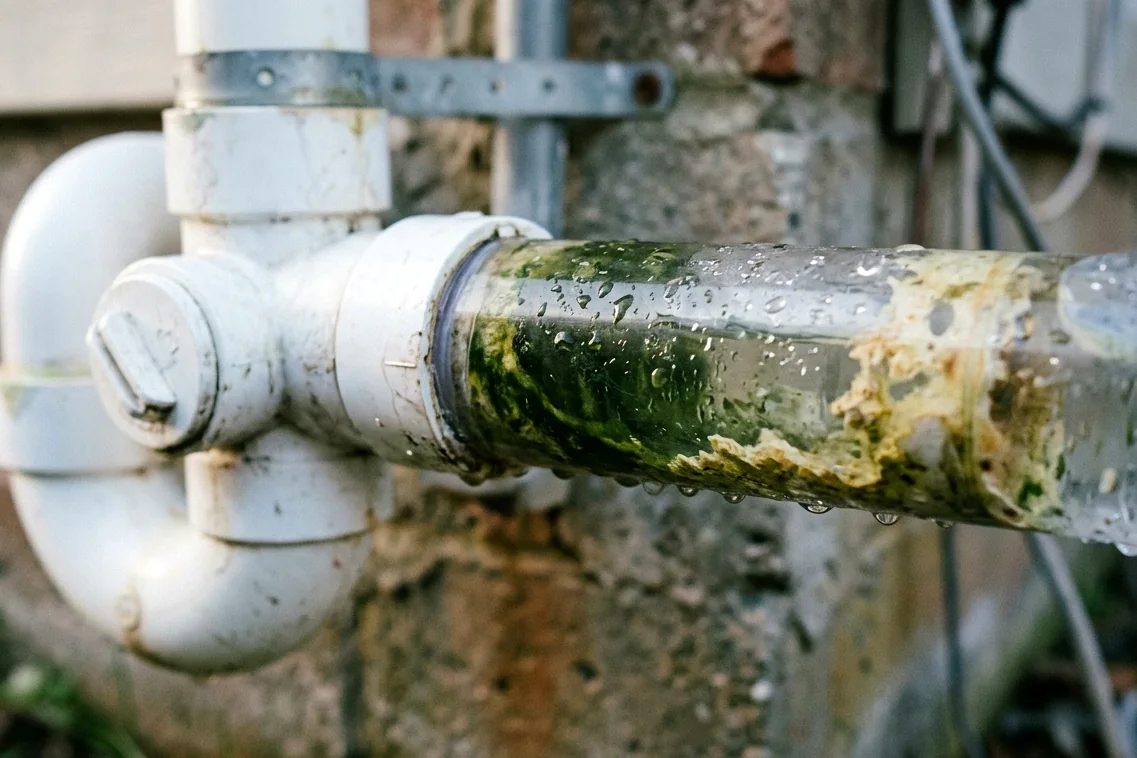
Drain lines clog for predictable reasons. A warm, damp, dark pipe is an ideal place for algae and bacterial slime. Fine dust that slips past filters settles into the pan and gets washed into the line. Phoenix hard water leaves mineral scale along the pipe walls, narrowing the opening. Over a season or two, these layers form a gel that stops water completely, often at the trap or at a tight elbow.
Cleaning the line properly takes more than pouring vinegar in from the top. Our technicians clear the blockage with vacuum or pressure, flush the full length of pipe, inspect the trap and vent, clean the pan, and test the float switch so it will shut the system down if the line ever clogs again. That last step is what keeps a minor clog from becoming a ceiling repair.
Signs to watch
Under an attic air handler, the secondary pan is a backup. Any water standing there means the primary drain is not keeping up and needs attention before it spills over.
A float switch in the pan or drain line cuts power when water rises. If your system stops cooling and the thermostat goes blank, a rising pan is a likely reason.
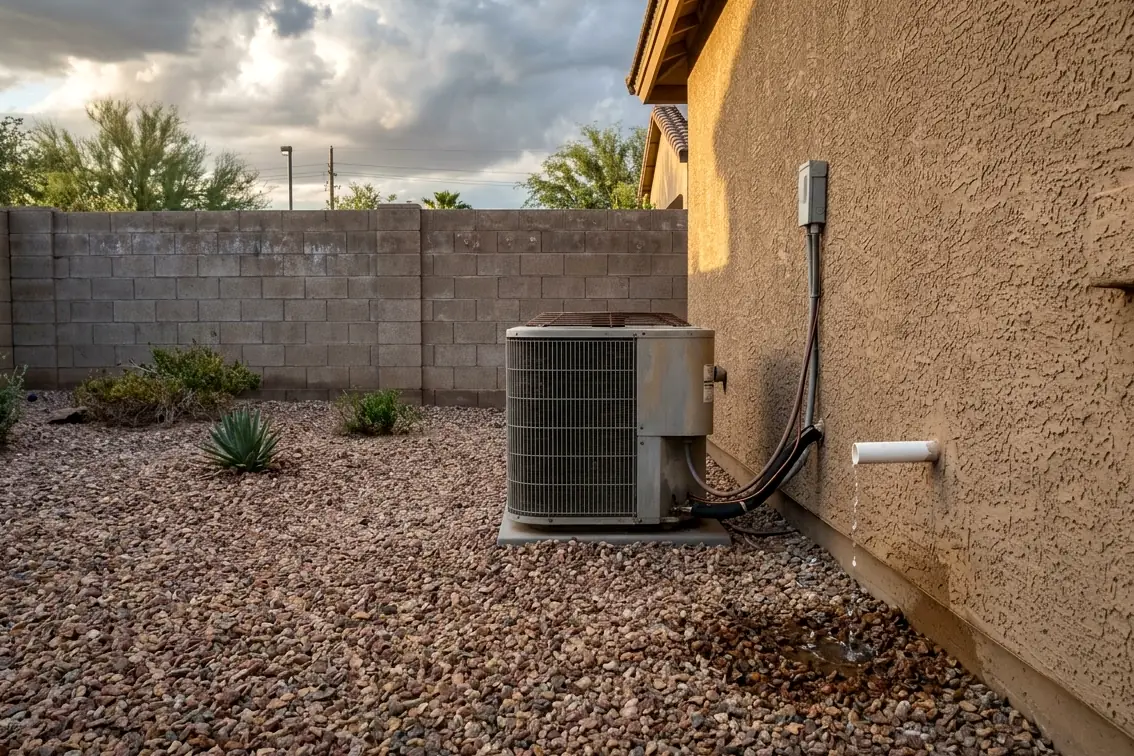
Most Phoenix homes have a drain outlet near the condenser or along a wall. If it stays dry on a hot humid afternoon while the AC runs, the line is probably blocked.
Bubbling or gurgling sounds near the indoor unit can mean water is backing up through a partly blocked trap. A clear line drains quietly without that sound.
Standing water in the pan grows mildew and bacteria. When the blower starts, that odor can travel through the ducts and reach every room in the house.
A water ring on the ceiling under an attic unit, or drips at a return grille, means water has already escaped. Turn the system off and call to limit damage.
People are often surprised that a desert AC produces so much water. During monsoon season, from June 15 through September 30, outdoor humidity jumps, and the coil pulls far more moisture than it did in May. A line that drained fine all spring can clog within days once that volume arrives, which is why we see a burst of drain calls in July and August.
Hard water and dust are the other local factors. Mineral scale coats the inside of PVC lines and traps, and dust that bypasses a loose filter turns into sludge in the pan. Attic heat accelerates algae growth in standing water. Because so many Valley air handlers sit above finished ceilings, a drain cleaning before monsoon season is one of the cheapest ways to avoid drywall and insulation damage.
How we handle it
We trace the line from the pan to its outlet, noting traps, vents, cleanout tees and any connection to plumbing. Knowing the route tells us where clogs are most likely to sit.
Water in the primary or secondary pan is vacuumed out first. That protects your ceiling while we work and lets us see cracks or rust on the pan surface.
A wet vacuum or pump at the outlet pulls the algae plug loose. For stubborn clogs we use controlled pressure from the cleanout, never enough to separate glued joints.
We flush the full length with clean water, then use a mild treatment that slows algae regrowth without harming PVC, the pan or the coil fins above it.
Lines that sag or lack a proper vent hold water and clog repeatedly. We check slope and the trap and point out any section that should be rerouted.
Finally we lift or flood the float switch to confirm it shuts the system down. A switch that does not cut power gives no protection when the next clog forms.
Before you call
Anything beyond these checks involves electrical parts or refrigerant, so call (602) 848-9399 and let a technician take it from there.
Typical cost
Typical drain line clearing and float test. A range, not a quote: the real number depends on what the technician finds. Full price guide
A straightforward clog cleared at the outlet usually lands in the lower part of this range. Long attic runs, damaged traps or a needed float switch push it higher. These are typical Phoenix ranges, not a quote. What you actually pay depends on what the technician finds along the drain path once it is opened and tested.
| Line item | Typical range |
|---|---|
| Condensate drain line clearing | $134 to $263 |
| Float switch installation | $146 to $287 |
| Drain trap or cleanout rebuild | $193 to $397 |
We repair and replace Trane, Carrier, Lennox, Goodman, Rheem, Daikin and most other makes found in Valley homes.
Related work
Indoor unit misbehaving? We repair air handler control boards, relays, transformers, drain pans, float switches and wiring in attics, closets and garages across Phoenix.
See air handler repairCapacitor tests, coil cleaning, drain flushing and refrigerant readings that catch weak parts in spring, before Phoenix summer heat finds them.
See ac tune-upSpring cooling and fall heating visits on a schedule, priority scheduling in summer and a service history that tracks your system year to year.
See maintenance plansA measured look at dust, humidity, fresh air and odors in your home, followed by targeted fixes like better filtration, ventilation or drain repairs.
See indoor air qualityWhere we do this
These communities make up most of the homes we serve. Each link opens the local page with ZIP codes, typical homes and the issues we see there.
For most Valley homes, once a year before monsoon season is a sensible schedule, ideally in May or early June. Homes with attic air handlers, a history of clogs or long drain runs may benefit from a midsummer check as well. We clean the drain on every AC tune-up, so if your system is on a maintenance schedule, the line is already covered.
A cup of distilled white vinegar poured into the cleanout can slow algae growth between professional cleanings, and it is generally safe for PVC. It will not clear a line that is already fully blocked, though, and it does nothing for hard water scale or a damaged trap. Avoid bleach in lines with metal pans or fittings, since it can speed up corrosion over time.
Monsoon humidity sends much more water through the line, and any slow spot from algae or scale shows up quickly. Repeated clogs often mean the line has poor slope, a missing vent, or a trap that holds debris. Dust bypassing a loose filter feeds the problem as well. We look for those root causes during the cleaning and explain what change would stop the yearly backup.
On many homes it exits through an exterior wall near the condenser or under an eave, often as a short PVC stub pointing down. Others drain into a laundry standpipe, a sink tailpiece or a roof drain on homes with package units. Some attic systems have a second line that drips over a window, which is a signal that the primary drain is blocked.
The clog itself does not usually ice up the coil, but rising water can trip the float switch and shut the system off, or overflow and soak the insulation around the air handler. In units without a working float switch, water can rust the pan and cabinet. Clearing the line early prevents both the shutdown and the slow damage that standing water causes.
Yes. Package units on flat or low-slope roofs have their own condensate pan and drain, usually running to a roof drain or gutter. Dust and bird debris collect there, and a blocked drain can let water pool in the unit base. We clear package unit drains the same way and check that water is not ponding on the roof near the curb.
A real person answers (602) 848-9399 every hour of every day, and we will tell you plainly what the next step is.