Capacitor and Contactor Replacement
The most common Valley summer failure: weak capacitors and pitted contactors tested with a meter and replaced from stock on the truck.
See capacitors & contactorsAc parts and repairs
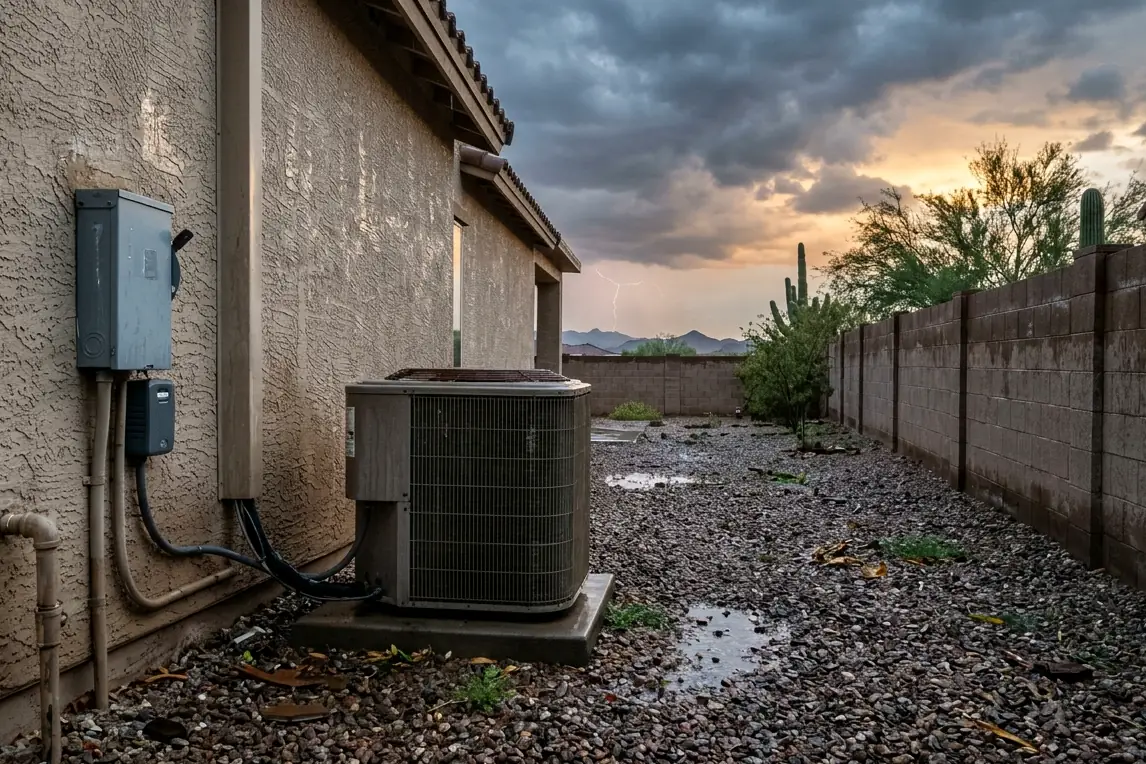
Monsoon lightning and storm-driven power surges are hard on the electronics inside your AC. A surge protector at the condenser, and at the air handler where it makes sense, takes much of that hit before your control board and compressor do.
At a glance
An AC surge protector is a small device wired at the outdoor disconnect, or inside the equipment, that diverts voltage spikes away from your air conditioner's control board, compressor, fan motor and capacitor. In Phoenix it's most valuable before monsoon season, when lightning, utility switching and power flickers send surges down the lines. It makes the most sense on newer variable-speed systems with costly electronics, and on any system that has already lost parts after a storm.
Every summer storm in the Valley brings a light show, and with it a wave of service calls. Lightning doesn't have to strike your roof to cause trouble. A strike on a nearby power line, or a utility switching circuits back on after an outage, can push a brief spike of high voltage down the wires and into anything that's running, including the outdoor unit humming away at 4 p.m. in August.
Air conditioners are especially exposed. The condenser sits outside on its own high-voltage circuit, and many newer systems carry inverter drives and circuit boards that are far more sensitive than the simple relays of older units. A single surge can scramble a control board, weaken a compressor's windings or kill a fan motor outright. Smaller, repeated surges do quieter damage, aging components until one fails on the hottest day of the year.
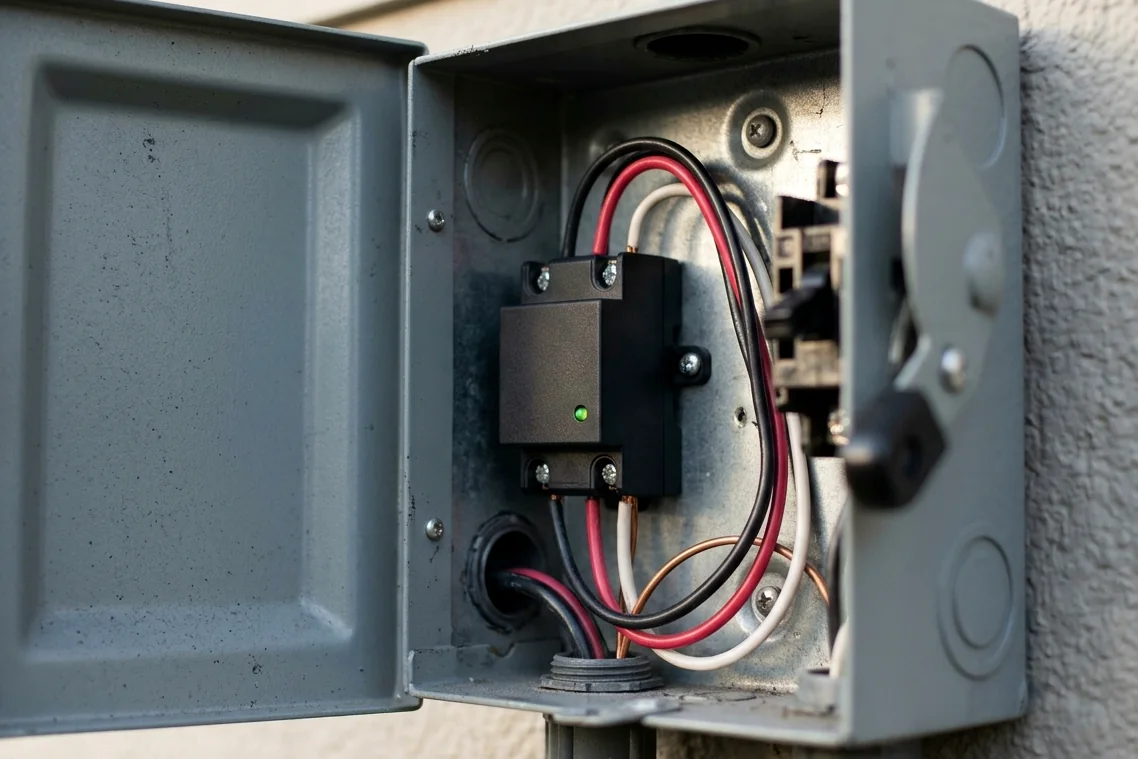
A dedicated AC surge protector sits between the power supply and your equipment and clamps those spikes before they reach sensitive parts. Our technicians mount it at the outdoor disconnect or inside the unit, wire it to the correct terminals and ground, and confirm that the indicator light shows it's active. For homes with an attic air handler or a package unit, we look at protecting the indoor side as well, since its board and blower motor face the same surges.
Signs to watch
If your AC stopped right after a monsoon storm or outage and needed a board, capacitor or motor, the next storm can do the same. Protection lowers that risk.
Inverter-driven compressors and communicating thermostats rely on circuit boards that are expensive to replace. Protecting them costs a small fraction of a single board repair.
Frequent flickers and brief outages on your street mean the grid is switching and surging. Each event sends a spike to whatever is running, including your condenser.
Without a whole-home surge device at the main panel, your AC's circuit has nothing between it and the utility line except a breaker, which does not stop surges.
Older Phoenix neighborhoods often have overhead power lines and pole transformers, which are more exposed to lightning than underground service in newer subdivisions.
A compressor that hums hard at startup or trips the breaker now and then is more vulnerable to surge damage. Protecting it buys time before a costly replacement.
From June 15 to September 30, Phoenix storms build fast over the mountains and roll across the Valley with lightning, wind and dust. Utilities work hard to keep power flowing, but downed lines, blown transformers and automatic switching that restores circuits all create voltage spikes. Your AC is running hard at exactly those moments, often at full load late in the afternoon, which is when a surge does the most damage to a compressor or control board.
Heat adds to the stress. Electrical parts that already sit in a 115°F cabinet run closer to their limits, so a spike that a cooler machine might shrug off can finish them. Capacitors and contactors are the classic summer failures, and our technicians replace plenty of them every July. Surge protection works upstream of those parts, reducing how often they're hit at all. It pairs well with a time-delay feature that keeps the compressor from restarting too soon after a flicker.
How we handle it
The technician inspects your disconnect, breaker size, wiring condition and grounding, because a surge protector only works when it has a solid path to ground for the spike.
We test the capacitor, contactor and control board for signs of past surge damage, so you aren't adding protection to a system with a part that's about to fail anyway.
Plug-style, disconnect-mounted and in-unit protectors each fit different setups. We choose the voltage, surge rating and features such as time-delay restart that suit your equipment.
With power off at the breaker, we mount the protector at the disconnect or inside the unit, connect it to the line terminals and ground, and seal openings against dust.
For attic air handlers, furnaces and package units, a second protector can give the blower motor and indoor board the same coverage as the outdoor condenser.
After restoring power, we verify the status light shows active protection, run the system through a full cycle and show you how to check the indicator after storms.
Before you call
Anything beyond these checks involves electrical parts or refrigerant, so call (602) 848-9399 and let a technician take it from there.
Typical cost
Typical condenser surge protector, installed. A range, not a quote: the real number depends on what the technician finds. Full price guide
Most Phoenix homes fall in this range for a quality surge protector installed at the outdoor unit. Adding protection at the air handler or choosing a model with time-delay restart raises the total. The real number depends on what the technician finds in your disconnect and wiring, and you hear the price before any wire gets touched.
| Line item | Typical range |
|---|---|
| AC surge protector at condenser, installed | $235 to $445 |
| Surge protection, condenser and air handler | $385 to $695 |
| Package unit surge protector, installed | $265 to $485 |
We repair and replace Trane, Carrier, Lennox, Goodman, Rheem, Daikin and most other makes found in Valley homes.
Related work
The most common Valley summer failure: weak capacitors and pitted contactors tested with a meter and replaced from stock on the truck.
See capacitors & contactorsConfirmed compressor failures replaced with matched parts, flushed lines and a fresh charge, or an honest comparison with a new system.
See compressor replacementOutdoor fan motors that stall, squeal or overheat repaired or replaced with correct horsepower, rotation and capacitor to protect the compressor.
See condenser fan motorIndoor unit misbehaving? We repair air handler control boards, relays, transformers, drain pans, float switches and wiring in attics, closets and garages across Phoenix.
See air handler repairWhere we do this
These communities make up most of the homes we serve. Each link opens the local page with ZIP codes, typical homes and the issues we see there.
A strike doesn't need to hit your home. Lightning on a power line, a transformer or even the ground nearby can push a spike through the utility wires or induce one in your home's wiring. That spike travels to anything connected, and your condenser and air handler sit on their own high-current circuits. Delicate electronics on the control board take the brunt, often failing instantly.
A protector wired at the disconnect guards everything downstream on that circuit: the compressor, condenser fan motor, capacitor, contactor and any outdoor control or inverter board. A second protector at the air handler or furnace covers the blower motor and indoor board. The thermostat and its low-voltage wiring benefit indirectly, since many surges reach them through the equipment they connect to.
It's a strong first layer, and we like seeing one. Panel devices stop large surges arriving from the utility. A dedicated AC protector adds a second layer right at the equipment, catching what passes through the panel and the spikes created inside the home as motors cycle. For expensive variable-speed systems, both layers together give much better coverage than either one alone.
No device can promise that. A direct strike carries enormous energy that can overwhelm any surge protector and damage wiring throughout the home. What an AC protector handles well are the far more common events: nearby strikes, utility switching and the spikes that follow monsoon outages. Those are what quietly destroy boards and compressors in Phoenix neighborhoods each summer.
Most protectors have an indicator light that stays lit or green while protection is active. After a large surge, the internal components sacrifice themselves and the light goes dark or changes color. Check it after big storms. Some models have replaceable modules, while others need a full swap. We also test it during tune-ups so a spent protector doesn't leave your system unguarded.
Yes, and it's one of the most useful features in Phoenix. When power blinks off and back on, a compressor that restarts instantly fights high pressure inside the system, which strains windings and can trip breakers. A time delay holds the restart for a few minutes so pressures settle first. During monsoon storms with repeated flickers, that delay spares the compressor several hard starts in a row.
A real person answers (602) 848-9399 every hour of every day, and we will tell you plainly what the next step is.