Commercial HVAC Maintenance
Quarterly or twice-yearly maintenance programs for business HVAC, with filter, coil, belt and drain service plus written reports by unit for managers.
See commercial maintenanceCommercial and rooftop
When a rooftop unit quits over a dining room or a retail floor, every hour costs you customers. We repair commercial RTUs, split systems and controls on Phoenix strip centers, offices and restaurants, around the clock.
At a glance
Commercial HVAC repair fixes heating and cooling equipment on businesses, usually rooftop units, split systems and the controls that tie them together. In Phoenix, common calls involve failed capacitors and contactors, broken belts, clogged condensate drains, compressor trouble and economizers stuck open. You need repair when a space won't hold temperature, units trip breakers, water drips from ceiling tiles, or tenants report hot zones in an office suite.
A commercial cooling failure in Phoenix is rarely just uncomfortable. A restaurant dining room with no cooling empties out by lunch, a retail suite at 88°F loses shoppers, and an office tenant starts calling the property manager every hour. Kitchen equipment and server closets add heat that a broken unit can't remove. That's why our commercial repair calls are answered 24/7 and dispatched with the urgency the space needs.
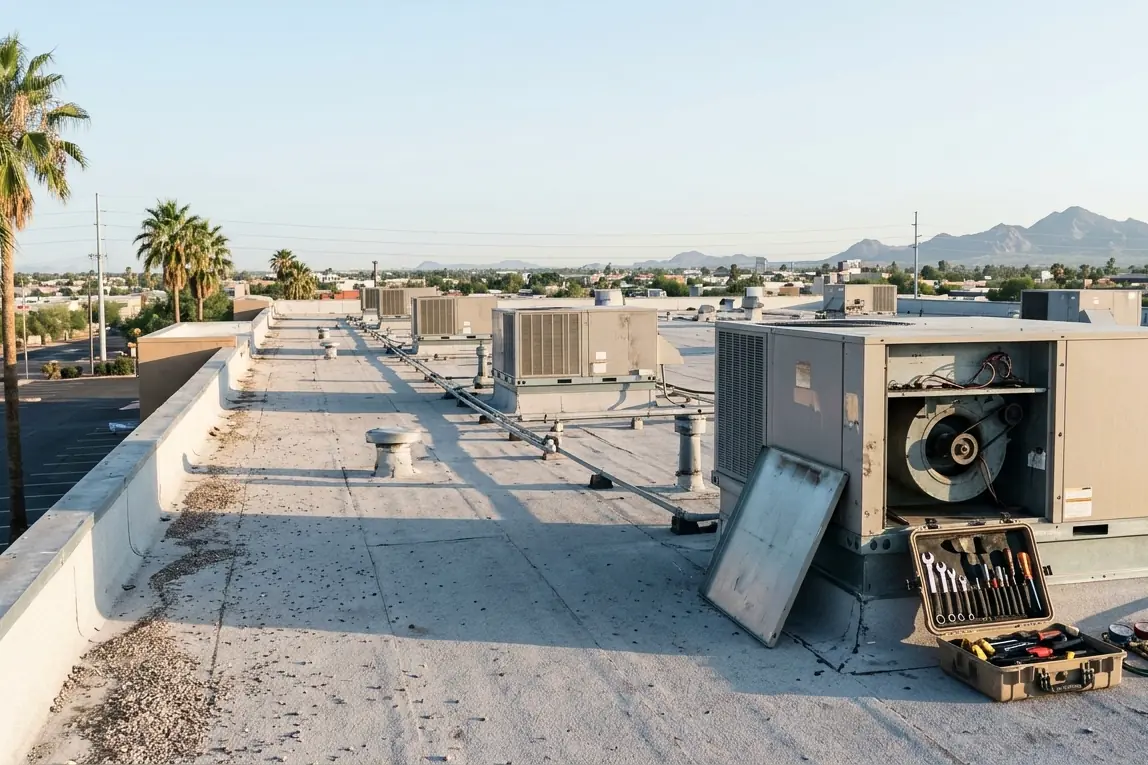
Most of the equipment we repair sits on the roof. Strip centers and office buildings across the Valley typically run one rooftop unit per suite, often belt-drive models with economizers and two compressor stages. We also repair split systems in small offices and medical suites, ductless units in server rooms and make-up air units tied to kitchen hoods. The technician brings common parts for each, so many repairs finish on the first visit.
Property managers and owners need clear information as much as a fast fix. After diagnosis, you get a plain explanation of what failed, what it costs to repair and whether the unit is close to the end of its useful life. We can coordinate with tenants for access, work around business hours when the repair isn't urgent, and send a written summary so you have a record for budgeting and lease discussions.
Signs to watch
When a space drifts several degrees above the thermostat setting through the afternoon, a unit may have lost a compressor stage, a fan motor or part of its refrigerant charge.
Stained or dripping ceiling tiles under a rooftop unit usually point to a clogged condensate drain or a cracked pan. Quick action prevents damage to merchandise, files and finishes.
Repeated trips at the disconnect or electrical panel signal a shorted motor, failing compressor or damaged wiring. Resetting it repeatedly risks bigger damage, so leave it off and call.
If air moves but feels warm, the compressor may not be starting, often from a failed capacitor or contactor. A stuck-open economizer pulling in 110°F outside air can cause it too.
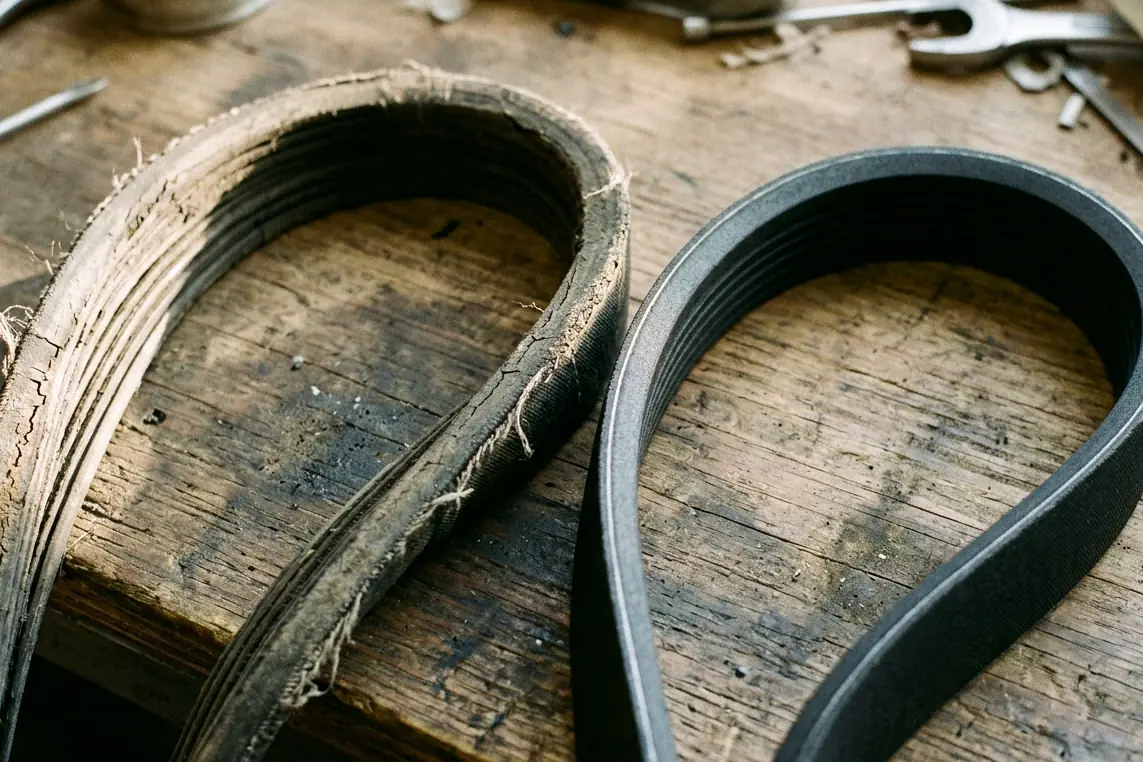
A squeal or slapping sound from the roof often means a worn or broken blower belt. Without the belt, the space gets no airflow, even though the compressor may keep running.
When one part of an office suite runs hot while the rest is fine, the problem may be a stuck damper, a failed zone control, a disconnected duct or a unit that's undersized for the space.
Before you call
Anything beyond these checks involves electrical parts or refrigerant, so call (602) 848-9399 and let a technician take it from there.
How we handle it
When you call, we ask about the business type, how many units are down, whether there's water or burning smell and how to reach the roof, so the technician arrives with the right parts and access.
The technician checks in with the manager or tenant, confirms which unit serves the problem area and arranges roof access. Business operations are disturbed as little as possible.
Power, capacitors, contactors, belts, motors and controls get tested with meters. Refrigerant pressures and temperature split are then measured to separate airflow, charge and compressor problems.
You get the cause, the repair options and the price before work starts. When a unit is old or the repair is large, we lay out repair versus replacement numbers in plain terms.
The technician completes the repair with parts on the truck when possible, or schedules a quick return for special-order parts and sets up a temporary fix if it's safe to do so.
After the repair, the unit runs a full cycle while temperatures and amperage are checked. A written summary goes to the manager or owner for records, tenant communication and budgeting.
Typical cost
Typical commercial repair. A range, not a quote: the real number depends on what the technician finds. Full price guide
Electrical repairs like capacitors, contactors and belts fall near the low end of this range, while motors, refrigerant leak repairs and control boards land higher. Compressor replacements on commercial units are priced separately. The real number depends on what the technician finds on the roof, and you see the price before any repair begins.
| Line item | Typical range |
|---|---|
| Commercial RTU capacitor, contactor or belt | $265 to $585 |
| Commercial blower or condenser fan motor | $845 to $2,485 |
| Commercial economizer repair | $465 to $1,385 |
Commercial roofs in the Valley often hold rows of rooftop units on flat decks with little shade. Storefront glass on strip centers faces parking lots that radiate heat well into the evening, and restaurant kitchens add heat all day. When outdoor highs reach 110 to 115°F, units designed for typical conditions run at full capacity for hours. Any weakness, like a dirty coil or worn belt, tends to show up as a failure during the hottest weeks.
Monsoon storms bring their own problems. Haboobs pack condenser coils and filters across entire roofs in minutes, and power surges can take out capacitors, contactors and control boards on several units at once. Economizers that let in outside air can let in dust too if their dampers or seals are damaged. Many of our busiest commercial repair days in summer follow a big storm.
We repair and replace Trane, Carrier, Lennox, Goodman, Rheem, Daikin and most other makes found in Valley homes.
Related work
Quarterly or twice-yearly maintenance programs for business HVAC, with filter, coil, belt and drain service plus written reports by unit for managers.
See commercial maintenanceSpring and post-monsoon maintenance for rooftop units on homes and businesses: coil cleaning, drain flushing, belt and motor checks and electrical testing.
See rooftop unit serviceNew and replacement rooftop units, split systems and ductless cooling for Phoenix offices, restaurants and retail suites, sized by load calculation for the space.
See commercial installationRepairs for rooftop and ground-pad package units, including capacitors, contactors, blower motors, drains and refrigerant leaks, on gas-electric and heat pump models.
See package unit repairWhere we do this
These communities make up most of the homes we serve. Each link opens the local page with ZIP codes, typical homes and the issues we see there.
Calls are answered 24/7, and commercial no-cooling calls get priority, especially for restaurants, medical offices and server rooms. Response time depends on demand and location, and during heat waves the busiest hours fill quickly. We give you a realistic arrival window on the phone and keep you updated if anything changes before the technician arrives.
Yes. Restaurants depend on rooftop units for dining room cooling and make-up air units to replace air exhausted by kitchen hoods. We repair both, including belts, motors, burners on heated make-up air units and controls. Kitchen grease can coat coils and filters faster than normal, so we often recommend a more frequent maintenance schedule afterward.
We work with property managers often. We coordinate tenant access, follow building procedures for roof entry, and send written summaries with readings, photos and costs. For buildings with several rooftop units, we can track repair history by unit so you can see which equipment is costing the most and plan replacements over time.
It depends on the repair cost, the unit's age and its repair history. A belt or capacitor is usually worth fixing on any unit. When an older RTU, especially one running R-22, needs a compressor or a major refrigerant repair, replacement often makes more sense. We'll show both numbers so you can decide with the building's budget in mind.
Hot spots in office suites often come from disconnected or crushed ducts above the ceiling, closed or broken dampers, a thermostat in the wrong spot, or added equipment like copiers and servers. Sometimes the unit is undersized for how the suite is used now. We check airflow at each diffuser and the duct path to find the cause.
Yes. Many small offices, medical suites and retail spaces in Phoenix use split systems or ductless mini-splits rather than rooftop units, and server rooms often have dedicated ductless cooling. We repair compressors, fan motors, controls, drains and refrigerant leaks on those systems with the same response as rooftop calls.
A real person answers (602) 848-9399 every hour of every day, and we will tell you plainly what the next step is.