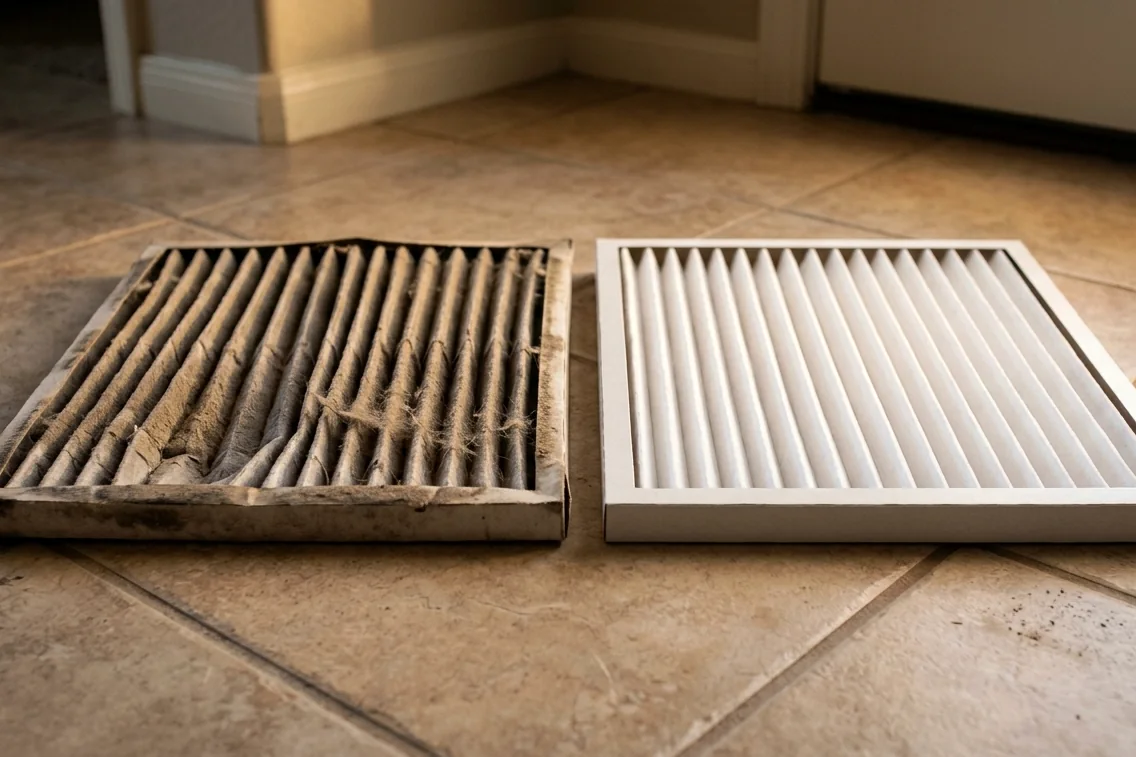
In Phoenix summers, a standard 1-inch filter often needs changing every 30 to 45 days, and sooner after a dust storm or during construction nearby. Thicker 4 to 5 inch media filters last longer, often several months. In the mild winter months you can usually stretch the interval. The surest rule is to look: if the filter is gray or you cannot see light through it, replace it.
Why do Phoenix filters clog faster than the label says?
Most filter packaging assumes average conditions and moderate run times. Phoenix offers neither. Fine desert dust finds its way into every house through door openings, small gaps around windows and leaky return ducts in hot attics. On top of that, the AC runs long cycles for months at a time, often through the night, so far more air passes through the filter each day than it would in a cooler climate.
Monsoon season adds dust storms that can load a filter in a single afternoon. Homes near open desert, unpaved lots or active construction see heavier dust year-round. Pets, cooking, carpets and ceiling fans all contribute too. The result is that a filter rated to last three months elsewhere may be visibly clogged in four to six weeks during a Valley summer.
How often should you change each type of filter?
These are starting points for a typical Phoenix home, not fixed rules. Adjust them based on what you see when you check the filter, how many pets you have, how often doors open during the day and how much dust your neighborhood gets. Writing the change date on the filter frame with a marker makes it easy to track, and a phone reminder every month in summer helps too.
- 1-inch pleated filter, summer: every 30 to 45 days
- 1-inch pleated filter, winter: every 60 to 90 days
- 4 to 5 inch media filter: often every 4 to 6 months
- Any filter after a major haboob: check within a day
- Homes with pets or nearby construction: check monthly
- Washable filters: rinse and dry fully on the same schedule
What happens when a filter stays in too long?
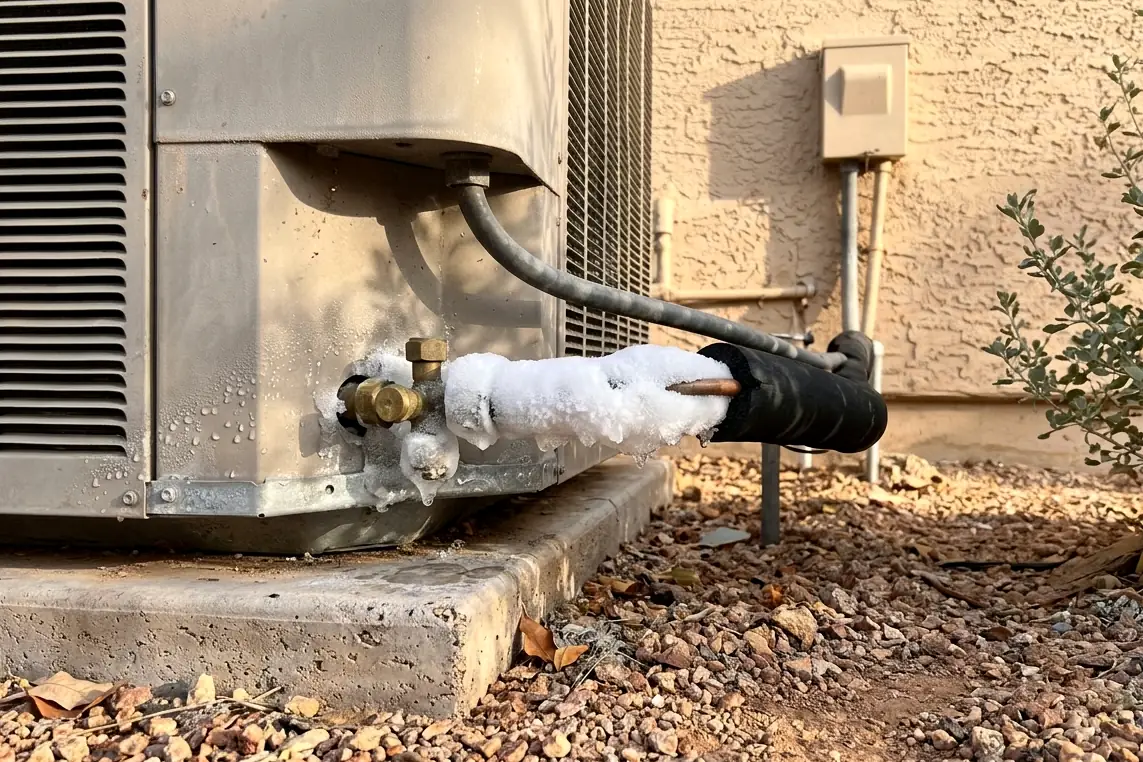
A clogged filter restricts airflow, and airflow is what an air conditioner depends on. With less air crossing the evaporator coil, the coil gets colder than it should. In Phoenix that often leads to ice forming on the coil and the copper suction line, which blocks airflow even more. When the ice melts, the extra water can overwhelm the condensate pan and drain, and in homes with attic air handlers that sometimes means a stained or damaged ceiling.
Restricted airflow also makes the blower motor work harder and run hotter, shortening its life. The system runs longer to reach the setting, raising your bill during the most expensive months. Dust that slips past a collapsed or overloaded filter coats the indoor coil, and a dirty coil is much harder and costlier to clean than a filter is to replace.
Which MERV rating makes sense for a Valley home?
MERV ratings describe how well a filter captures particles of different sizes. Higher numbers catch finer particles, but they can also restrict airflow more, especially in a 1-inch format. For many Phoenix homes, a 1-inch pleated filter in the MERV 8 to 11 range is a good balance between capturing dust and keeping airflow healthy. Very high-MERV 1-inch filters can choke systems that were not designed for them.
If you want better filtration for allergies or dust, a thicker media filter cabinet is usually the better route. A 4 to 5 inch filter has far more surface area, so it can capture fine particles while keeping resistance low, and it lasts longer between changes. Some homes benefit from whole-home filtration upgrades that are sized to the blower and ductwork, rather than simply buying a denser 1-inch filter.
Where is your filter, and how do you change it correctly?
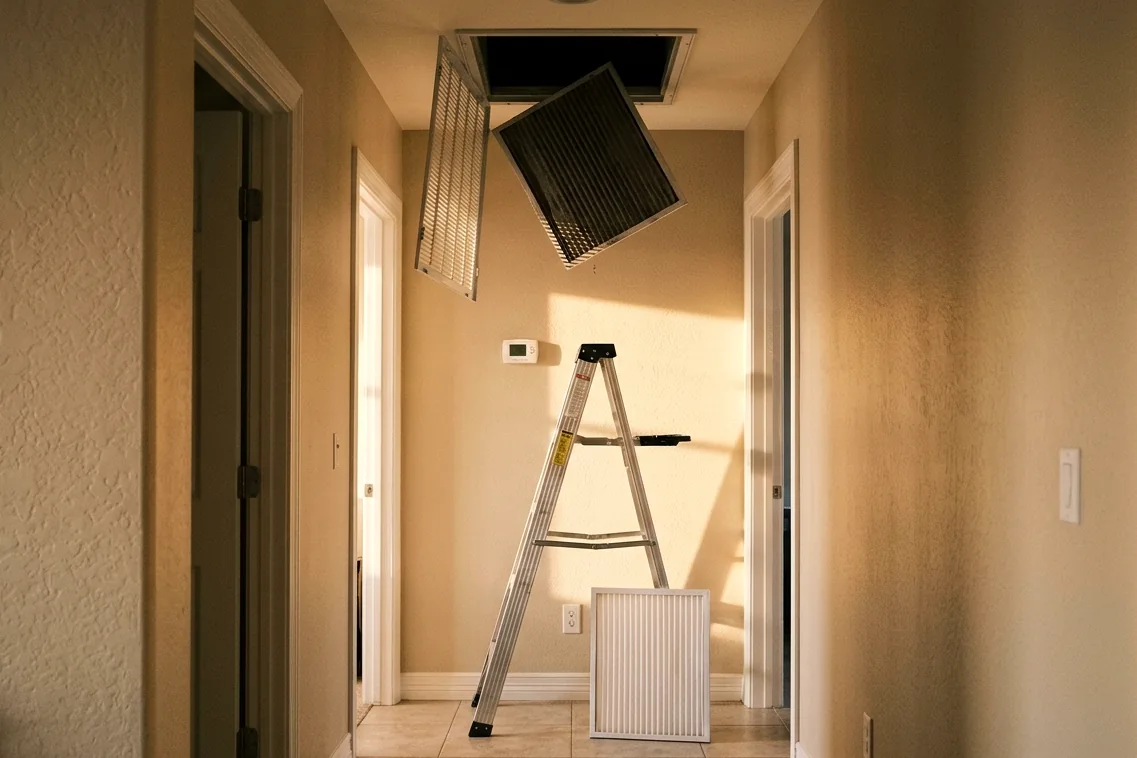
Phoenix homes hide filters in a few common spots. Many have a filter grille in a hallway ceiling or wall that serves as the main return. Homes with a hall closet air handler often have the filter in a slot at the base of the unit. Some homes with attic equipment have the filter at the air handler itself, which is less convenient and easier to forget. Roof package unit homes usually have a ceiling return grille with the filter behind it.
- Turn the system off at the thermostat before removing the filter
- Note the size printed on the frame and buy the same size
- Point the airflow arrow toward the air handler, away from the room
- Make sure the filter sits snugly with no gaps around the edges
- Close the grille fully and turn the system back on
What if your home has more than one return?
Many larger Phoenix homes, two-story houses and homes with more than one system have several return grilles, and each may hold its own filter. All of them need changing on the same schedule, since a single neglected filter still restricts the system it serves. If you are not sure how many filters your home has, our technicians can point out every one during a tune-up and note the sizes for you.
It also helps to make sure returns are not blocked by furniture, curtains or stored items. A return grille hidden behind a couch starves the system of air in the same way a dirty filter does. Keep at least a foot of clear space in front of every return, and avoid closing supply registers in unused rooms, since that can raise pressure in the duct system.
When is a filter problem really a system problem?
If your filter clogs unusually fast, the cause may be outside the filter itself. Leaky return ducts in the attic can pull in dusty, superheated air and insulation fibers, loading the filter and raising your cooling load at the same time. A filter that bows inward or gets sucked out of its slot can point to an undersized return. Heavy dust on the supply registers suggests air is bypassing the filter. Our technicians can check return duct sealing, static pressure and filter fit. Call (602) 848-9399 if you are changing filters constantly and still fighting dust.